Showing posts with label UNFCCC. Show all posts

Saturday, November 24, 2018

National Security Priorities: Do We Have It All Wrong?

A random comment on the national news this morning got me thinking: There was more violence in malls in this country yesterday than there is at the border. You know, that caravan of "threatening" people fleeing violence or poverty in search of a better life. The ones that we have deployed troops against -- troops who have authorization to use lethal force. We are all too familiar with violence in this country - be it mass shootings, sexual assault, or rage in our malls or on our highways. Yet we turn our angst and actions against the unknown, those "others" that we fear may change who we are as a country, despite being a nation built by immigrants. These desperate people to the south of our border are our modern day boogeymen.
Statues depicting climate refugees at COP15 in Copenhagen
Meanwhile, a headline that many of us may have missed came out of Paris over the past week: Paris Peace Forum Recognizes Climate Change, Food Insecurity, Water Scarcity as Challenges for Peace and Security. Our government defends a lot of our actions by claiming they are in the interest of national security but, in my opinion, it fails to recognize where the very real threats lie.

A report from the BBC news and other outlets earlier in the week about the conflict in Yemen declared 85,000 children 'dead from malnutrition'. I can't begin to fathom their agony, or that of their families. Blockades keep humanitarian aid from reaching those in dire need of food and medical care. This fatality statistic doesn't include all the civilians who have been killed by airstrikes from the Saudi-led coalition, attacks that involve support from the United States. And, by all accounts, millions more in Yemen are at risk of starvation and disease. Remind me again about what threat we are targeting in this country? What exactly is the national security argument? Maybe I am naive, but allowing tens of thousands of children to die horrific deaths and targeting innocent people with our military power, might just tick off an awful lot of people. Maybe even more than there are terrorists in Yemen currently.

Water scarcity exacerbated by a drought that began in 2006 is widely identified as a factor leading to the ongoing civil war in Syria. Around a half million people have died and there are millions of displaced people leading to a refugee crisis from that multi-year conflict. Some experts have questioned whether this is a "climate war". At the very least, many believe that "anthropogenic climate change will become a ‘threat multiplier’ for instability in the decades ahead." [1] If you don't want to bother with the academic literature, Christian Parenti's book Tropic of Chaos: Climate Change and the New Geography of Violence or Alex Alvarez's Unstable Ground: Climate Change, Conflict, and Genocide are eye-opening reads.

The 4th National Climate Assessment was released yesterday, on the heals of the latest report by the IPCC: Global Warming of 1.5 °C. Here is the "CliffNotes" bottom line message from the highly technical IPCC report:
Climate-related risks to health, livelihoods, food security, water supply, human security, and economic growth are projected to increase with global warming of 1.5°C and increase further with 2°C.
The graph from Climate Action Tracker shows you where things stand; the current pledges from the Paris Agreement for greenhouse gas emissions (the major contributor to climate disruption) are far from adequate to limit warming of our planet to less then 2°C.
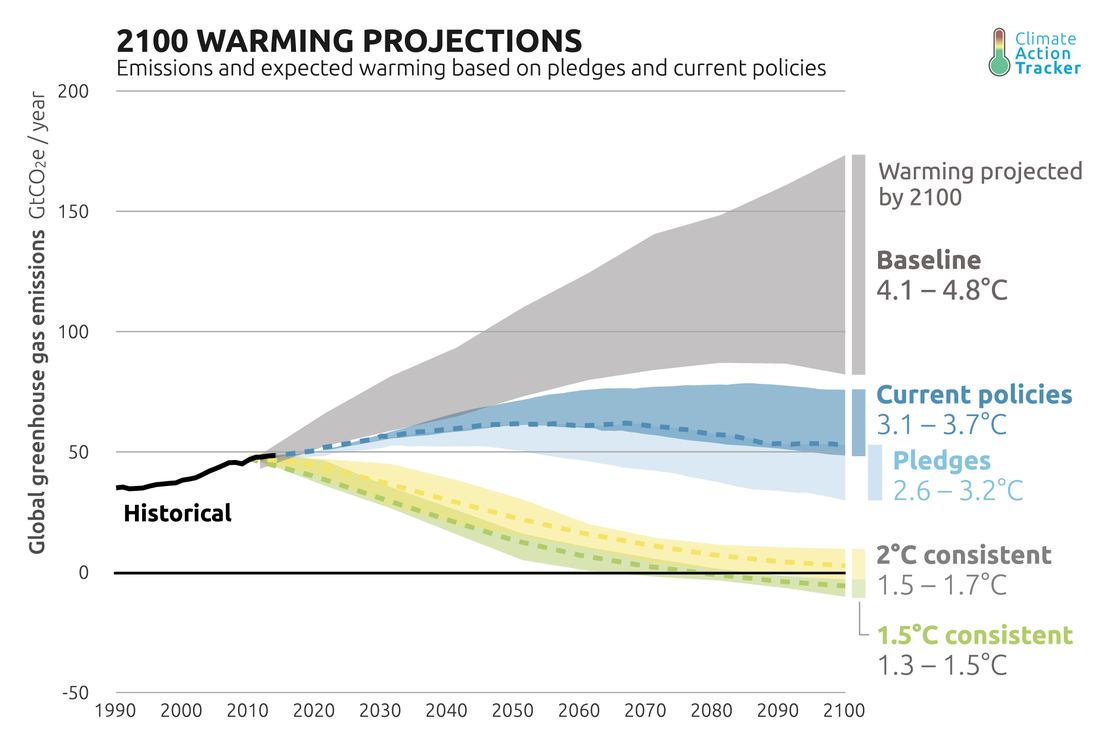
Furthermore, according to the IPCC: 
The risks depend on the magnitude and rate of warming, geographic location, levels of development and vulnerability, and on the choices and implementation of adaptation and mitigation options (high confidence).
Avoiding overshoot [of warming above 1.5°C] and reliance on future large-scale deployment of carbon dioxide removal [i.e. geoengineering] can only be achieved if global CO2 emissions start to decline well before 2030 (high confidence).
The year 2030 is not very far away. If you haven't read the details of the Paris Agreement, it focuses on post-2020 actions. Hence the use of the word "pledges" in the above graph.

These are very real threats to our national security, but for the most part, we have yet to address them. Instead of seriously considering our "choices and options" related to mitigation and adaptation, we have largely focused on inaction. Pascal's Wager reminds us that this is typically not the wisest option. Denial and deflection, a previous failure to ratify the now defunct Kyoto Protocol, and more recently, threats to withdraw from the Paris Agreement, have been our modus operandi towards climate change policy. Our borders are under threat, but it is our coastlines that will be washed away with sea level rise. Maybe we need seawalls rather than a wall along the border with Mexico. In the southwest, drought contingency plans are being considered as the serious water shortages in that region of the country will impact our own citizens. [2]
According to NASA, rainfall may decline by 20 to 25 percent over California, Nevada, and Arizona by 2100.
Maybe officials in the southwest are taking note of the water-shortage crisis that Cape Town faced this past year. We have already seen record loss of human life and property from the devastating fires in California, fires which have been made worse by (yes, I am going to say it) climate change. The current numbers of migrants or refugees seeking food, shelter, and protection pale in comparison to what we may face in the coming decades with climate migrants. [3] And some of those displaced people could be U.S. citizens.

Less you think that climate refugees are a problem for the distant future, I invite you to watch a short video that a colleague sent me yesterday with the message: "Thankful we live on high islands in Hawai'i, our Marshallese neighbors are not so fortunate." [An aside since I have been mentioning conflict and war: the Marshalls were an American nuclear testing site in the 1950s with 50 plus bombs dropped there.]

Against this backdrop, and amidst tweets of climate change denial and plans for our administration to promote the virtues of coal, I head to Poland with students in a week to attend the 24th meeting of the Conference of the Parties of the United Nations Framework Convention on Climate Change. The most recent "1.5°C report" from the IPCC is on the agenda. The first of the IPCC reports was published in 1990, and the messages within it brought nations together at the Rio Earth Summit in 1992 to develop the UNFCCC and to act in the interests of human safety even in the face of scientific uncertainty. Now, almost 30 years later and with solid scientific evidence for a changing climate, we still haven't figured out how to solve one of the greatest challenges facing humanity.


[1] Selby, J.,  O.S. Dahi, C. Frohlich, and M. Hulme. 2017. Climate change and the Syrian civil war revisited. Political Geography 60: 232 - 244. https://www.sciencedirect.com/science/article/pii/S0962629816301822

[2] N. Baptiste. 2018. This is What a West Without Water Will Look Like. Mother Jones Magazine, published March 15, 2018.  https://www.motherjones.com/environment/2018/03/this-is-what-a-west-without-water-will-look-like/

[3] Parker, L. (2018) 143 Million People May Soon Become Climate Migrants. National Geographic Online, published March 19, 2018. https://news.nationalgeographic.com/2018/03/climate-migrants-report-world-bank-spd and K.K. Rigaud, A. de Sherbinin, B. Jones, J. Bergmann, V. Clement, K. Ober, J. Schewe, S. Adamo, B. McCusker, S. Heuser, and A. Midgley, Amelia. 2018. Groundswell : Preparing for Internal Climate Migration. World Bank, Washington, DC. © World Bank. https://openknowledge.worldbank.org/handle/10986/29461 License: CC BY 3.0 IGO.


Thursday, November 9, 2017

Just a typical day at the COP

COP meetings can be overwhelming, even for those of us who have been coming for many years. There are many negotiating tracks that one can follow, a lot of jargon, and way too many acronyms. And just when you begin to learn the proverbial ropes, a new agreement or workstream comes along with another set of vocabularies to learn!

There are daily constituency meetings; my mornings typically start with the Research and Independent NGOs meeting since I serve on the RINGOs steering committee. It is a chance for participants to review what is going on in the various tracks that they are following; a "Cliffs Notes" version of what is progressing (or not). This is helpful for those who cannot be everywhere at once or who aren't inclined to sit through too many lengthy negotiations sessions that often move at a snail’s pace. At the end of these meetings, it is often a good time to check in with students from Moravian’s delegation. Today, the researchers from the U.S. – many of them representing the next generation of scientists and lawyers who will work in the environmental field – gathered to discuss an upcoming meeting with the U.S. delegation (i.e. from the State Department of the only country that is now publicly pulling away from the Paris Agreement). Oh, what an interesting conversation that will be!

Three women in STEM and from the Rocky Mountain Science and Sustainability Network
For those of us who are not policy wonks, there is much more than negotiations to follow. The side-events are a lot like going to a professional conference with panels and presentations on a wide range of topics. For instance, today happens to be “Business and Industry Day” at COP23. Yesterday was “Young and Future Generations Day.” Since we will be discussing corporate responses to climate change in our course soon, I ventured into a session entitled Transforming the Industry: The Case for Transparency and Ambition in Markets and NDCs. (See what I mean about jargon and acronyms?) The session was billed as a time to  
"Discuss the chances and challenges energy intensive industry is facing on the way to GHG-neutrality; Identify how the framework and instruments of the Paris Agreement can support industry on its way to become GHG-neutral by 2050; showcasing (inter)national initiatives that contribute thereto."
I listened to information about carbon pricing, the company Bosch’s story (or propaganda, depending on your perspective), the ability to purchase certificates (carbon offsets), and ways to become more energy efficiency. Yawn. The business world, like many scientists, needs to learn to be a bit less dull.

A typical session audience


Next, I was going to go to a session titled Hacking climate change: The digital future of climate leadership, innovation and impact sponsored by Microsoft and interestingly the South Pole Group! The room was standing room only, so I moved to another session entitled Achieving Socially and Ecologically Beneficial Renewable Energy Systems through Community Engagement in part because one of the sponsors was the Leonardo DiCaprio Foundation (Planet Pledge initiative). The content is worthy of a separate blog post, but in short, the session was about how the demand for rare metals to support renewable energy technology and the computerized energy efficiency systems is creating new ecological destruction and having negative social consequences for many in the developing world (think conflict minerals). The problem of climate change is complex, but so are potential solutions.

Besides the negotiations and side events, many countries have pavilions where they offer their own programming along with some cultural flare, and there are countless exhibitions from NGOs, universities, think tanks, and other organizations. Having come to these events for many years, I enjoy wandering around reconnecting with interesting friends from around the world, including people I met at the community-based adaptation conference in Uganda last summer from Bangladesh and Zanzibar, representatives from Mediators Beyond Borders International, faculty from other campuses, etc. I had two back-to-back conversations with people who had been in Svalbard this past summer! It is, ironically, a network of friends with a high carbon footprint from travel. Tonight, I will have dinner with a French glaciologist who studies in Scotland and does research in polar regions. And that is a typical day at a COP meeting: exhausting, but never dull.


Some scenes from around the COP:


Yes, those are lights made from hollowed out fish!


The last 4 images are from the Fiji Pavilion - the official host of COP23 even if we are in Bonn


Saturday, November 4, 2017

Destination: COP 23

I am at the airport awaiting my flight to Bonn, Germany to attend the annual U.N. climate conference – COP23. This will be my 9th such trip having first attended COP15 in Copenhagen in 2009, and I find myself reflecting upon what has changed over that time span.


As a refresher, the United Nations Framework Convention on Climate Change (UNFCCC) was one of three treaties to come out of the Rio Earth Summit held in 1992. The framework was enacted in 1994, and the first Conference of the Parties or COP1 was held in 1995. Parties are the signatories to the agreement -- the nations working to find ways to mitigate the problem (largely by working to reduce greenhouse gas emissions) and to adapt to the impacts of a changing climate.

When Moravian College delegates attended COP15, the sense of optimism was unmistakable; with a new administration in the White House, many felt that the shift in priorities and perspectives would finally result in progress towards developing a new significant international agreement on climate change. Despite that optimism, it would take until 2015 in Paris for that agreement to finally happen. And then, one year later, the results of the U.S. election came in while we were attending COP22 in Marrakech. The mood immediately shifted from excitement about working on implementation of the Paris Agreement to a gloomy sense of a new uncertainty. Despite decades of scientific data telling policymakers what should be done, it was immediately obvious that politics of just one country – mine – can quickly overshadow all the will and hard work to address such a global challenge.

If my experience at the Community-based Adaptation Conference in Uganda this summer is any indication, any delegate from the U.S. attending COP23 will face difficult questions, frustration, criticism, and even anger about the anti-climate change rhetoric and lack of cooperation on implementing the provisions of the Paris Agreement coming from the U.S.

The news is not all discouraging. The #WeAreStillIn initiative of U.S. cities, corporations and institutions of higher education (including Moravian College), the dramatic global progress being made in switching to renewable, non-carbon based energy sources, and the innovations occurring in technology, companies, and other countries – rich and poor alike – are all signs of hope.

Here in the terminal, as I chat with the students who are part of our delegation this year, I can’t help but notice their enthusiasm. Of course, they are excited to be traveling to a new country, but they are also eager to participate in COP23 and share stories through our blog to those back home. For four years, they have been studying environmental issues – the science and policy – and now, they will get to participate in the nexus between the two at the international level. They understand the severity and urgency associated with the challenge of climate change. They are frustrated by the climate denial and inaction in the U.S. Yet, they, like my own sons who are about the same age, are not without hope that we can still make a difference at the local and global level to address this challenge.

The UNFCCC process has its flaws. It is complex and slow. But 197 nations agreed to the provisions of the Paris Agreement. Think about that: 197 countries in agreement about something. As of this week, 86% of those countries have ratified that agreement through their own internal processes. The Paris Agreement opened the door to the private sector, cities and sub-national governments across the world to participate and innovate; over the past two years, we are seeing what the U.N. refers to as “game-changing actions.” The agreement sent strong signals to markets -- where to invest and where not to. Faith-based communities across the globe believe that, as stewards of all creation, we have a moral obligation to address climate change. And developing countries are beginning to leapfrog dirty, outdated technologies as they work to raise their standard of living.

This week, I will be sharing my reflections on what has changed during the past nine years since my first COP -- in terms of the scientific understanding, the technology, the policy and politics, the public attitudes and the role that I have played. As we attend COP23, we will all be reporting on the issues and our perceptions on the progress being made toward implementing the Paris Agreement provisions. Hopefully, we will provide some glimmers of optimism along the way.

Nature decrees that we do not exceed the speed of light. All other impossibilities are optional. 
Robert Brault

Wednesday, May 10, 2017


The Rights of the Child

“Those who suffer the most, contribute the least” is an oft-used phrase in climate negotiations.  This can pertain to residents of small island developing states, indigenous peoples, and children. It conveys the urgent need for those most responsible for the climate crisis to act expeditiously and earnestly to reduce the causes and effects of climate change, in part out of moral obligation to reduce the impacts on the most vulnerable of populations that are least to blame.

On the opening day of the UNFCCC meeting, there was a featured event held by the Presidency of the Conference of Parties (COP) 22 on the Rights of the Child. The event highlighted climate change issues affecting children and emphasized how human rights must be incorporated into climate change policy. Children are among the most vulnerable to the impacts of climate change, including physical and mental distress, loss of opportunities for education, effects of displacement, loss of traditional knowledge, and increased likelihood of exploitation. The event featured testimony from people directly affected and those working on behalf of children. A video was shown featuring a young woman affected by Typhoon Haiyan that hit the Philippines in November of 2013; she conveyed a heart-wrenching story of the loss of her parents and other family members in the flood waters, and the lack of food, water, sanitation and medication afterwards. This was shown as an example of the effects of increased storm intensity already being felt and projected to increase in the future. 

There was a recommendation for all Parties to integrate children’s rights into mitigation and adaptation policy decisions through the UNFCCC and through the implementation of the UN Sustainable Development Goals (SDGs).  Suggestions were made to ensure that school and health care facilities are built to withstand storms and sea level rise. There was also a plea to empower children to participate in climate change policymaking through education.

This was an important discussion highlighting our responsibility to younger and future generations. That it was a Presidency Event held in the large Plenary Room highlighted its significance. 


Monday, May 8, 2017

Opening Plenaries at the Bonn Climate Change Conference May 2017

This morning was the Opening Plenary session for the Subsidiary Body for Scientific and Technological Advice (SBSTA) at the UN Climate Change Conference in Bonn. Most of the Opening Plenary consisted of establishing the working groups and procedures for the rest of the conference; these working groups will focus on various agenda items and have their recommendations ready before the Closing Plenary. Parties to the Conference were able to provide comments on certain agenda items, and there were two main areas of emphasis: the need for transparency in climate finance and accounting (to avoid double counting), and the need to consider indigenous peoples when implementing clean development and adaptation measures. There was also discussion about the need to account for emissions from fuel used for international aviation and maritime transport, and a call for international standards on data collection and a collective strategy for reducing greenhouse gases in this sector. The goal is for a plan by the end of 2018, implemented through the International Maritime Organization. After this discussion, NGOs provided comments, which included concern (and disdain) for agriculture, forestry and other land use offsets, the lack of attention given to food security, and the need to address issues that affect youth, calling for a joint platform by SBSTA and the Subsidiary Body for Implementation (SBI) to elevate issues that affect youth and indigenous peoples. 

Following the SBSTA was the Opening Plenary for the SBI.  Comments from the Chair, Mr. Tomasz Chruszczow, included that progress made in Paris was irreversible and irrevocable, that we need to demonstrate trust for State and non-State actors, and that we all needed to work together against our biggest competitor: time.

During this opening session, Ambassador Khan of Fiji was introduced.  Fiji will head the next Conference of the Parties (COP) in November in Bonn. Ambassador Khan expressed concern for those in the Pacific facing Cyclone Donna, the worst cyclone on record in May; she cited this cyclone as an example of why Fiji felt compelled to host the next COP.  Fiji has been working with the German government and the UNFCCC to prepare for the COP and welcomes any and all opportunities to engage with interested parties.  The Prime Minister of Fiji will be visiting the conference next week to echo these sentiments. 

The agenda for the next two weeks promises to be full and lively.  I look forward to the progress towards implementing the Paris Agreement.


Wednesday, November 16, 2016

Moral Courage

 
It is a rare that one has the opportunity to be in a room with a great leader, with someone who is articulate, passionate, and willing to show both courage and emotion on the international stage. Today was such a day.

Secretary Kerry started a briefing – his last at a COP as Secretary – by graciously thanking Special Envoy Jonathan Pershing, the U.S. delegation to the COP, and all the international partners - on this, his last speech to a COP as Secretary. He talked about returning to COP23 as citizen Kerry. He told a story of Churchill and Roosevelt traveling to Marrakech during WWII -- through active combat and with plenty of scotch - to view the sunset on the Atlas Mountains. He later would quote Churchill about not just doing what is right, but what is required. And he would go on to quote Pope Francis. This was not a typical briefing.

Kerry spoke of progress - in the UNFCCC, in clean energy innovation and adoption, in the strong message that the Paris Agreement has given the private sector. But he also spoke of the work that is yet to be done, sharing dramatic observations from his recent trips to the Arctic and Antarctica along with frightening statistics of the predicted new demand for energy, especially in southeast Asia, much of which is slated to come from coal.

The Secretary chastised countries that, with one hand, pat themselves on the back for all the progress they are making, but then, with the other hand give money to support the building of new coal-fired plants in developing nations. He expressed the need for urgency and more ambitious action given the pace at which the planet is changing and gave dramatic examples of the costs of inaction.  Countries, Kerry noted, couldn't "bask in the glow of Paris." And they could not fail, as this "would not be political failure, but a moral failure."

And then the moment when the audience held its breathe - when Kerry chose to speak about the fear and uncertainty people were feeling after the U.S. election. He, of course, couldn’t predict what will happen, but noted that he could say with confidence that issues look quite different when you are in office compared to the campaign trail. He challenged the new administration and anyone who is “conflicted about which road to follow” to “see for themselves, to do their own diligence, to see why so many are moving on this.” He urged them to talk to economists about the risk of inaction, Fortunate 500 companies, military leaders, farmers, faith leaders, and young people. And he told them that “above all, consult with the scientists who have spent their lives working on this” and not let their work be in vain.

Repeatedly, Kerry said that climate change shouldn’t be a partisan issue, but that it is one that will exacerbate conflict around the world. He urged people to talk with the intelligence community about global stability, increasing food prices and risks to human health. To talk with the mayors from cities in the southern states who are dealing with sunny day floods and to conservative business leaders who are holding their supply chains responsible for the ecological and carbon footprints.

Kerry had begun his briefing-turned-speech by saying that climate change was a personal issue for him. Many thought he was referring to how much he had worked on the international negotiations under the UNFCCC, but instead, he reflected on the first Earth Day and the teach-in he participated in, the first climate conference in Rio where he met his wife, the moment in Paris when he thought the "world had finally found the way forward" and this past April - again on Earth Day. On that day, he had invited his daughter to the United Nations in New York City where he would sign the Paris Agreement on behalf of the United States. This towering politician of international renown talked about playing with his granddaughter as he awaited his turn. In a spontaneous decision, he carried her on stage with him so that she would be part of the important moment in history and a symbol for the audience of what is at stake.

Here is the text of the speech.
~~~~~~~~~~
This all brought to mind this poem by Rudyard Kipling
If: A Father's Advice to His Son

If you can keep your head when all about you
Are losing theirs and blaming it on you,
If you can trust yourself when all men doubt you,
But make allowance for their doubting too;

If you can wait and not be tired by waiting,
Or being lied about, don't deal in lies,
Or being hated, don't give way to hating,
And yet don't look too good, nor talk too wise

If you can dream - and not make dreams your master;
If you can think - and not make thoughts your aim;
If you can meet with Triumph and Disaster
And treat those two impostors just the same;

If you can bear to hear the truth you've spoken
Twisted by knaves to make a trap for fools,
Or watch the things you gave your life to, broken,
And stoop and build 'em up with worn-out tools

If you can make one heap of all your winnings
And risk it on one turn of pitch-and-toss,
And lose, and start again at your beginnings
And never breathe a word about your loss;

If you can force your heart and nerve and sinew
To serve your turn long after they are gone,
And so hold on when there is nothing in you
Except the will which says to them: 'Hold on!'

If you can talk with crowds and keep your virtue,
Or walk with Kings - nor lose the common touch,
If neither foes nor loving friends can hurt you,
If all men count with you, but none too much;

If you can fill the unforgiving minute
With sixty seconds' worth of distance run,
Yours is the Earth and everything that's in it,
And - which is more - you'll be a Man, my son!”

Moral Courage

 
It is a rare that one has the opportunity to be in a room with a great leader, with someone who is articulate, passionate, and willing to show both courage and emotion on the international stage. Today was such a day.

Secretary Kerry started a briefing – his last at a COP as Secretary – by graciously thanking Special Envoy Jonathan Pershing, the U.S. delegation to the COP, and all the international partners - on this, his last speech to a COP as Secretary. He talked about returning to COP23 as citizen Kerry. He told a story of Churchill and Roosevelt traveling to Marrakech during WWII -- through active combat and with plenty of scotch - to view the sunset on the Atlas Mountains. He later would quote Churchill about not just doing what is right, but what is required. And he would go on to quote Pope Francis. This was not a typical briefing.

Kerry spoke of progress - in the UNFCCC, in clean energy innovation and adoption, in the strong message that the Paris Agreement has given the private sector. But he also spoke of the work that is yet to be done, sharing dramatic observations from his recent trips to the Arctic and Antarctica along with frightening statistics of the predicted new demand for energy, especially in southeast Asia, much of which is slated to come from coal.

The Secretary chastised countries that, with one hand, pat themselves on the back for all the progress they are making, but then, with the other hand give money to support the building of new coal-fired plants in developing nations. He expressed the need for urgency and more ambitious action given the pace at which the planet is changing and gave dramatic examples of the costs of inaction.  Countries, Kerry noted, couldn't "bask in the glow of Paris." And they could not fail, as this "would not be political failure, but a moral failure."

And then the moment when the audience held its breathe - when Kerry chose to speak about the fear and uncertainty people were feeling after the U.S. election. He, of course, couldn’t predict what will happen, but noted that he could say with confidence that issues look quite different when you are in office compared to the campaign trail. He challenged the new administration and anyone who is “conflicted about which road to follow” to “see for themselves, to do their own diligence, to see why so many are moving on this.” He urged them to talk to economists about the risk of inaction, Fortunate 500 companies, military leaders, farmers, faith leaders, and young people. And he told them that “above all, consult with the scientists who have spent their lives working on this” and not let their work be in vain.

Repeatedly, Kerry said that climate change shouldn’t be a partisan issue, but that it is one that will exacerbate conflict around the world. He urged people to talk with the intelligence community about global stability, increasing food prices and risks to human health. To talk with the mayors from cities in the southern states who are dealing with sunny day floods and to conservative business leaders who are holding their supply chains responsible for the ecological and carbon footprints.

Kerry had begun his briefing-turned-speech by saying that climate change was a personal issue for him. Many thought he was referring to how much he had worked on the international negotiations under the UNFCCC, but instead, he reflected on the first Earth Day and the teach-in he participated in, the first climate conference in Rio where he met his wife, the moment in Paris when he thought the "world had finally found the way forward" and this past April - again on Earth Day. On that day, he had invited his daughter to the United Nations in New York City where he would sign the Paris Agreement on behalf of the United States. This towering politician of international renown talked about playing with his granddaughter as he awaited his turn. In a spontaneous decision, he carried her on stage with him so that she would be part of the important moment in history and a symbol for the audience of what is at stake.


~~~~~~~~~~
This all brought to mind this poem by Rudyard Kipling
If: A Father's Advice to His Son

If you can keep your head when all about you
Are losing theirs and blaming it on you,
If you can trust yourself when all men doubt you,
But make allowance for their doubting too;

If you can wait and not be tired by waiting,
Or being lied about, don't deal in lies,
Or being hated, don't give way to hating,
And yet don't look too good, nor talk too wise

If you can dream - and not make dreams your master;
If you can think - and not make thoughts your aim;
If you can meet with Triumph and Disaster
And treat those two impostors just the same;

If you can bear to hear the truth you've spoken
Twisted by knaves to make a trap for fools,
Or watch the things you gave your life to, broken,
And stoop and build 'em up with worn-out tools

If you can make one heap of all your winnings
And risk it on one turn of pitch-and-toss,
And lose, and start again at your beginnings
And never breathe a word about your loss;

If you can force your heart and nerve and sinew
To serve your turn long after they are gone,
And so hold on when there is nothing in you
Except the will which says to them: 'Hold on!'

If you can talk with crowds and keep your virtue,
Or walk with Kings - nor lose the common touch,
If neither foes nor loving friends can hurt you,
If all men count with you, but none too much;

If you can fill the unforgiving minute
With sixty seconds' worth of distance run,
Yours is the Earth and everything that's in it,
And - which is more - you'll be a Man, my son!”

Tuesday, November 15, 2016

An Accidental Ambassador

Photo credit: Gillian Bowser

I came to Morocco ten days ago for the U.N. climate meetings, to play a role in linking scientific researchers to each other and to policymakers, and to obtain updates on issues related to mitigation of and adaptation to climate change. Besides making sure that my absentee ballot was sent in on time since I would be away on Election Day, I had not put much thought into the impact that the timing of the election would have on the climate change negotiations or my being in a predominantly Muslim country.

This COP is focused on implementation – for Parties to hammer out details of putting the Paris Agreement into action, to work on areas where agreement had not yet been reached last year at COP21, and to try to get countries to be more ambitious in their pledges (and preferably verifiable action) to lower greenhouse gas emissions. Everyone coming to Marrakech knew that finance issues still required difficult negotiation work, be it for financing technology for a low carbon future, for helping developing nations to adapt to the current and future impacts of a changing climate, or for perhaps the most contentious issue of all, compensation under the provisions of the Warsaw International Mechanism for Loss and Damage associated with Climate Change Impacts.

The conference started off normally. Then, a different sort of 9/11 occurred. The world awoke on the 9th of November, day 3 of COP21, to the shocking news that Donald Trump had been elected president of the United States. The very candidate who has tweeted about climate change being a hoax, who has vowed to pull the U.S. out of the Paris Agreement and to defund U.N. initiatives, and yes, the one who has made all sorts of negative rhetoric about Muslims.

It is still uncertain whether all of this was simply hollow campaign speech making to gain support from certain constituencies. But when I see high school classmates, people I have known all my life, posting statements like “No more Muslims or Mexicans in the country, time to celebrate,” I know we have much to worry about.

I would love to be a fly on the wall in the meetings of the U.S. delegation to get a better sense of their fears (beyond their job security in the State Department or at NOAA or NASA). Are their hands now tied as far as negotiations? As a civil society observer, I do not have the ability to influence policy at that level, but instead am limited to discuss with like-minded friends back home ways that we can organize, rally, and try to create climate friendly policy and practices at the local level. I have been surprised at how many emails and Facebook messages I have received from former students and community members -- all expressing their fears for the future and looking to me for a glimmer of hope. I am not sure how to provide what they are looking for, but I have come to realize that there is some intangible importance to my being in this place at this moment.

By being here, I have somehow fallen into a role of diplomacy making, an odd thing for a scientist, who grew up being rather a-political, and certainly knowing little about Arabic culture. The people of Morocco are incredibly welcoming, but it seems as if everywhere I go, the locals – waiters, shopkeepers, ticket sellers at the train station – have a need to mention the election and ask about our new president. After they ask if I voted for him (I did not), they relax a bit and begin to talk more. As typical, at dinner one night last week, the waiter asked where we are from, and then made some comment about the election results. But then he asked why American's don't like Muslims. My heart dropped. I told him that wasn't the case for all of the people in my country.

None of us know what the future holds, so we speculate and try to find some hopeful signs between the sound bites that pass for news these days. As we share some mint tea and kind words of empathy, we come to realize how much we have in common besides our fear – our mutual desire for three main things: peace, a good future for our children, and a planet that remains habitable. This then, becomes my mission – to find what binds us together, rather than differentiates and divides us. For it is these common goals that will give us the strength and guidance to solve much more than the global climate challenge.

Tuesday, November 8, 2016

The Rest of the (News) Story in 2016


For the past year (it seems like so much longer), the airwaves in the United States have been dominated by campaign noise. Occasionally, this noise has been punctuated by some actual news such as the stories about Hurricane Matthew, the struggle of refugees coming from war-ravaged areas, and forest fires in the western states or the central U.S. (and if you pay attention to international news, Siberian boreal forests). In case you had not thought about it recently, Haiti is still in ruins after Hurricane Matthew, described just last week as a “blighted apocalyptic landscape of wrecked homes and growling hunger.” And you may have missed them with all the campaign static, but there have also been several news stories related to climate change, besides the ones I mentioned above.

In October, there was a historic agreement reached to cut hydrofluorocarbons (HFCs) – avoiding the release of significant amounts of CO2-equivalent emissions. In 2015, reports indicated that there had been a dramatic rise in HFC emissions between 2007 and 2012 due largely to air conditioning – an increase of around 33 million tonnes per year of this very powerful greenhouse gas. The Kigali Agreement will cap and phase down HFC consumption starting with developed nations in 2019.

On November 4th, the Paris Agreement, negotiated at COP21 in 2015 went into force (i.e. became international law). This is the first agreement were all countries have specific pledges to reduce greenhouse gas emissions. As of November 8th, 102 (of 197) countries have ratified this agreement which has as one key goal to limit planetary warming to below 2°C over the pre-Industrial levels.

Yesterday (November 7th) COP22 began. Under the United Nations Framework Convention on Climate Change (UNFCCC), Parties or signatories of the 1992 agreement are committed to address the global problem of climate change. At the annual Conference of the Parties or COPs, multilateral negotiations related to climate change policies occur. You may wonder why this group needs to continue to meet if so much progress was made last year. Part of the answer to that question is that the current commitments of individual countries to reduce greenhouse gas emissions are insufficient to meet the planetary temperature goal of the Paris Agreement. These intended nationally determined contributions (INDCs), when added up, are projected to only limit warming to around 3.5°C, and that is only if the countries actually abide by their pledges.

A goal of continued negotiations then is to get deeper cuts in emissions, to have countries move towards these more ambitious cuts sooner, and to have the conversion to a low carbon future in order to limit warming to, not 2°C, but rather to 1.5°C. Scientific models show that the 1.5°C warming limit may – just may – limit sea level rise associated with climate change so that it won’t completely drown out several small island nations and coastal communities. To get there, not only will each country need to be more ambitious with their INDCs, but the Parties will also need to address emission sources not currently covered such as the bunker fuel emissions from maritime shipping in international waters.

Monitoring and verification mechanisms, carbon markets, adaptation, and finance related to both loss and damage due to climate change impacts and technology development needed to green our national economies are just a few of the other issues that need to be addressed in negotiations. It is only day 2 of COP22 and I have already heard much more about geoengineering and negative carbon emissions (reducing CO2 from the atmosphere) than usual. With my science background, these terms are code for “plan B” to save the planet. To others, they are terrifying concepts of hubris, our belief that our technological developments can “fix” everything.

I suspect that the reason for the increased emphasis on technological "solutions" may be due to some other pieces of news that have likely gotten lost in the campaign noise. Last year, 2015, was the warmest year globally on record and we crossed the 1°C mark for global average temperature increase. For the first three months of 2016, the global average temperature was hovering around 1.2°C warmer than pre-Industrial times. Sea level rise is occurring faster than any time in the past 2800 years. And we learned that the 2011-2015 mean September sea ice extent was 30% below the 1981 – 2010 average. This information is not from models, but from actual scientific measurements. Perhaps the scariest headline from all of this is that scientists believe it may now be impossible to limit global warming to the 1.5°C target.

These are very big news stories that may be linked to severe weather events and conflict happening around the world. But despite the importance of these issues, they apparently were not significant enough to be discussed in any detail during the presidential debates, and at best, were a blip on the evening news.

Today, those annoying political ads will end. For days or weeks after the election, Americans will come to grips with the outcome of a contentious election, and political pundits will analyze what it all might mean. What likely won’t be in the news during that time is that thousands of people from 197 countries will be in Marrakech for two weeks trying to save humanity from a very real crisis that is happening regardless of which national leader is elected back in the United States.

Monday, December 7, 2015

A Look Back, as Week Two of COP21 Begins

Over the weekend, the draft text for a Paris Agreement was released. This is the document that high-level ministers from countries around the world will focus on during week two of COP21. They will negotiate the details and unresolved issues, and hopefully, they will come to consensus on an international accord. All sorts of individual experts and members of non-governmental organizations have been analyzing the details of this draft since Saturday. You may see media coverage and reactions from the legal community, politicians, and civil society over the next week. But for anyone reading this blog, some perhaps for the first time, it might be useful to look back to see what brought the world to this pivotal moment and to understand the overarching goals of the COP meetings.


The UNFCCC negotiations process is full of acronyms and jargon, starting with its name. The United Nations Framework Convention on Climate Change is essentially a treaty – one of three that was signed at the Rio Earth Summit in 1992. Each year, there is a Convention of the Parties, or COP session, where delegates from different countries around the world meet to hold consultations, to negotiate, and to attempt to come up with solutions to both the causes and impacts of global climate disruption. This year, COP21 represents 21 years of negotiations post-Rio – longer than many of my students have been alive.

The main goal of the multilateral UNFCCC agreement, which now has 196 Parties or signatories, is to “stabilize greenhouse gas concentrations in the atmosphere at a level that would prevent dangerous anthropogenic interference with the climate system.” Yet solutions to this challenge have been evasive. Despite extensive scientific evidence that demonstrates how rising levels of atmospheric greenhouse gases (GHG) destabilize the climate and research tools that allow us to model the impacts that will result from such destabilization, mitigating the problem (i.e. reducing GHG emissions) is not a simple task.

The world has long been reliant on fossil fuels to drive technology, development, and the global economy. Carbon dioxide, the GHG that is a product of combusting these fossil fuels, is one of the main contributors to climate change and thus, you often hear reference to a low-carbon future or decarbonization. (There are differences, but they aren’t necessary to explain in this post.) Different countries have different national processes for ratifying international agreements, Several billion people around the world still either live in extreme poverty or have a significantly lower quality of life than most in the United States can even image. And according to the provisions in the Framework Convention of 1992, consensus of all Parties must be reached. Thus, economics, politics, vast inequality gaps, and the need to change human behavior in order to address climate change all present significant barriers. Try to imagine a committee meeting where 196 individuals were in attendance and, before leaving, all in attendance had to agree on a long list of items about priorities and actions they would be committed to for the next several decades. Again, not an easy task.

Despite these complexities, some progress has been made over the decades. The Kyoto Protocol was adopted in 1997 and entered into force in 2005. Under this agreement, 37 industrialized nations and the European Community committed to reduce greenhouse gas emissions – to an average of five percent against 1990 levels. The U.S. Senate never ratified this agreement, so our country was noticeably absent from the agreement, despite our long being one of the largest contributors to GHG emissions. During the second commitment period under this Protocol (2013 – 2020), Parties pledged to reduce GHG emissions by at least 18 percent below 1990. Again, the United States did not agree to this and several other nations who had been Parties to the original Kyoto Protocol (all large GHG emitters) backed out (1).

For a number of reasons, 2015 has been viewed as the year that a strong agreement aimed at resolving climate change would finally be reached. At COP17 in Durban, South Africa (2011), the Durban Platform -- a new platform of negotiations under the Convention was launched

to deliver a new and universal greenhouse gas reduction protocol, legal instrument or other   outcome with legal force by 2015 for the period beyond 2020 (2).

In other words, this was the year the world was to replace the Kyoto Protocol with a new legally binding agreement that included all Parties to the UNFCCC, not just the developed nations. So at COP21, you see much reference to the ADP working group – which stands for “Advancing the Durban Platform.” A few years ago in Warsaw (COP19), a plan for allowing countries to find different paths to mitigation was set forth providing flexibility for finding ways to reduce carbon emissions. The Intended Nationally Determined Contributions or INDCs were to be submitted by each Party in advance of COP21, and by the opening of the conference, 181 countries had done so. Add this to the commitments announced by two of the largest GHG emitters, the U.S. and China, in November 2014, and it seemed as though there were at last major breakthroughs.

The year of 2015 was also when the United Nations finalized the post-2015 Sustainable Development Goals that are aimed at addressing the large inequalities around the world. Compared to the Millennium Development Goals, the new SDGs have a stronger focus on environmental issues, including climate change, so the links between addressing the needs of developing countries and addressing the disparate impacts of environmental problems are now more clearly defined.

Finally, the newest science clearly indicates that the window for reducing carbon emissions in order to keep the planet from experiencing more than a 2 degree Celsius increase in temperature may be closing. There is much controversy about this target, since models show that even that amount of global temperature increase will have devastating impacts, particularly on small island nations and coastal areas due to sea level rise and on already rapidly declining biodiversity. The INDCs that have been submitted to date will not even get us to this 2° target. And even if against all odds, an ambitious legally binding agreement is reached at COP21 in 2015, it won’t go into effect until 2020 and the reduction of GHG emissions will occur over an even longer timeframe. These pollutants have residence times in the atmosphere measured in years, so even if we were to stop all GHG emissions tomorrow, the problem doesn’t immediately go away. Since the beginning of the Industrial Revolution, the planet has already warmed by 0.8°C, and all indications are that 2015 will be the warmest year on record, possibly pushing that overall global warming to 1°.

Yes, much is at stake here in Paris. The world faces many complex problems including terrorism, food insecurity, poverty, an ever-growing inequality between the haves and have-nots, economic uncertainties, and many forms of environmental disintegration. But, in the eyes of many, no problem is more important and urgent than addressing the one of climate change. That is why 150 heads of state gave impassioned speeches on the opening day of COP21. And that is why so many people here are calling this an issue of human rights.

Please wish the world leaders luck going forward this week. They are going to need it, along with courage and strong political will.

Moravian College students discussing the status of negotiations at COP21


1. See http://unfccc.int/kyoto_protocol/items/2830.php
2. See http://unfccc.int/key_steps/durban_outcomes/items/6825.php