Thursday, December 6, 2012

The Cost of Inaction


In a post from December 3rd, I mentioned the most recent report of the Intergovernmental Panel on Climate Change (IPCC) Managing the Risks of Extreme Events and Disasters to Advance Climate Change Adaptation (SREX).[1]  Just a few days later, Typhoon Bopha hit the Philippines.  Yet another extreme weather event.  From December 7th update of the international edition of The News:

“A quarter million people were homeless and 477 confirmed dead after the Philippines' worst typhoon this year, officials said Thursday, as the government appealed for international help.”[2]

Hundreds of people are missing, a fourth of the country’s banana crop is destroyed, homes are in rubble, villages are gone. 

“Officials said many of the 477 dead victims were poor migrants who found work at landslide-prone sites such as New Bataan and nearby Monkayo towns, either at unregulated gold mines or at banana plantations.”

Last year, the night before the opening of COP17, there was a strong (and unusual) storm that hit Durban. The victims were relatively few in number, but all from poor shanty towns on the outskirts of the host city.  According to the Worldwatch Institute, in 2011, there were 820 natural catastrophes around the planet, resulting in almost 30,000 deaths and close to $400 billion in economic losses.[3]   When I read that press release back in April, I was struck by the fact that insurance companies are keeping tabs on this type of thing, which of course, makes perfect sense.  In the case of the Worldwatch Institute report, the data had been compiled by Munich Reinsurance Company and analyzed by WWI’s Vital Signs series.  Worldwatch President Robert Engelman was quoted as saying

“The steady increase in losses from natural catastrophes around the world demonstrates the need for preventative measures to the world’s poorest and most vulnerable communities  ...These communities often have little beyond their own wits and meager resources to help them recover from a crop failure, the destruction of a home, or the tragic loss of a family’s breadwinner.”

In sharp contrast, New Jersey Governor Chris Christie went to Washington today to ask for aid for his state after the devastation left by Hurricane Sandy in October.  The Los Angeles Times reported today that New York and New Jersey alone have requested $79 billion in disaster relief.[4]

WASHINGTON, DC, November 23, 2009 – World Wildlife Fund (WWF) and the leading insurer Allianz SE released a report today warning that sea level rise could dramatically increase risks to buildings, transportation infrastructure and other assets exposed to severe storm surges in coastal areas of the U.S. The study estimates that current assets at risk to a 1-in-100-year storm surge amount to $1.4 trillion. A mid-century global sea level rise of 0.5 meters (20 inches), with an additional 0.15 meter (6 inches) localized rise along the northeast U.S. coast, could jeopardize assets worth close to $7.4 trillion [emphasis added].[5]

If you take into account other economic impacts in developed nations – such as air travel disruption, impacts on electric-utility operations, temporary shut downs of extractive industries and community businesses, etc. – real costs of extreme weather events are significantly higher.  No wonder there has been so much talk in Doha of “Loss and Damage.”  But how exactly do negotiators and insurance actuaries account for loss of life or put a price tag on grief?

I am reminded once again of the comment from my Kenyan friend, Samwel, in an email just before I left for Qatar:

“Climate change is now speaking for itself and it’s up to us humans to act, to mitigate, or suffer the consequences.”

In many news feeds today there was coverage of the emotional pleas of the chief negotiator for the Philippines, Naderev Saño, pleas which echo those of Samwel:

“As we sit here in these negotiations, even as we vacillate and procrastinate here, the death toll is rising.  There is massive and widespread devastation.  Hundreds of thousands of people have been rendered without homes.  And the ordeal is far from over, as typhoon Bopha has regained some strength as it approaches another populated area in the western part of the Philippines.

I appeal to the whole world, I appeal to the leaders from all over the world, to open our eyes to the stark reality that we face.  I appeal to ministers.  The outcome of our work is not about what our political masters want.  It is about what is demanded of us by 7 billion people.

I appeal to all, please, no more delays, no more excuses.  Please, let Doha be remembered as the place where we found the political will to turn things around.  Please, let 2012 be remembered as the year the world found the courage to find the will to take responsibility for the future we want.  I ask of all of us here, if not us, then who?  If not now, then when?  If not here, then where?”

Our colleagues from York College in PA had another op-ed published this week in the Huffington Post expressing the growing frustration amongst youth.[6]  Two Arab youth activists from Libya and Algeria were expelled from the conference today.  Their offense?  Displaying a banner that read: “Qatar: Why host and not lead?”  A coalition of NGO’s today issued a statement claiming that the climate talks in Doha were “sleepwalking toward disaster.”[7]

I completely understand this frustration.  The science tells us what we should be doing.  Those paying attention to events around the world don’t even need the science.  But we should all be screaming about the inaction and the costs that we will eventually pay because of it. 

At a previous UNFCCC meeting, the youth wore blue t-shirts worn by youth at a previous U.N. meeting that included a quote from Christina Ora, a youth delegate from the Solomon Islands in 2009:

"You have been negotiating all my life. You cannot tell me you need more time."

Apparently, the negotiators think we have time.  After all, even if a new legally-binding agreement is reached (by 2015), it likely won’t go into effect until 2020.  So let’s start keeping a tally of measurable costs of damage due to extreme weather events, along with the loss of life and livelihood.  The cost of inaction is likely to be very high indeed.


Tuesday, December 4, 2012

Student perspectives from Doha

I highly recommend that you read the excellent posts from students representing the American Chemical Society to get a range of perspectives on the negotiations and side events from youth attending COP18.

Find posts from Parker, Nikki, Marla (from Moravian College), and John at
http://www.studentsonclimatechange.com/cop18-student-participants.html

Marla, Nikki, John, and Parker in Souq Waqif in Doha

Blogging in the Le Park Hotel lounge


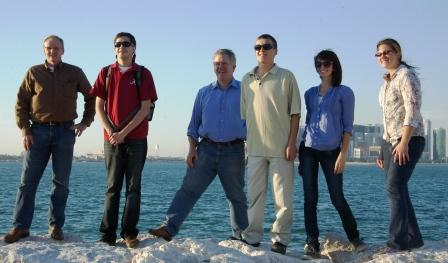
Marla and I left Doha on Sunday night, but had a chance to interact with the three other students for a day of transition and sightseeing in the city.  These students are at the UNFCCC with Keith Peterman and Greg Foy, two chemistry faculty members from York College, also in PA.  Keith and Greg recently had an op-ed in the Huffington Post: http://www.huffingtonpost.com/keith-peterman/un-climate-conference-in-_b_2214621.html  

A second op-ed appeared on December 4th that focuses on the youth perspective from this group of students:  http://www.huffingtonpost.com/greg-foy/un-climate-change-youth-i_b_2228472.html

The chemists in Doha

It is great that two PA liberal arts colleges have such great representation at the COP meeting and in the press (Huffington Post, and my interview with NPR's Paul Brown last week).

Sadly, we couldn't stay for the full two weeks, but I will be following the events as they unfold this week.


Opening ceremony to kick off the high level segment of the COP18/CMP8


Well, I am back in the states, totally jet-lagged, but juggling to keep up with the meetings in Doha and meeting my classes for the last week of the semester before final exams.

I am working on a blog post related to the "wish list" of outcomes for Doha that was developed last week, so that readers can compare this with the actual outcomes that hopefully emerge later this week.  In the meantime, an interesting newsletter came out today (The Earth Negotiations Bulletin, available online at http://www.iisd.ca/climate/cop18/enb/, see bulletin for December 4th) from today's opening ceremony to kick off the high level segment of the COP18.  In other words, this is the time period where the true negotiations begin, and we might finally begin to know the cards of individual countries.  There are some important directions given from the key speakers which I comment on below.  

My comments are in black and the excerpts from the bulletin are in blue and italics.

From the bulletin:

On Tuesday afternoon, the opening ceremony of the COP 18 and CMP 8 high-level segment took place. In the morning, afternoon and evening, contact groups and informal consultations convened under the COP, CMP, ADP, AWG-LCA and AWG-KP.

Interpretation:

More alphabet soup so common to these meetings. These acronyms are the various tracks working in parallel to develop draft language to be considered by the high level negotiators within the Conference of the Parties. I think that the key ones to highlight here are:

- ADP: ACTION ON THE DURBAN PLATFORM (from last year's COP17) -- This group will draft the language of the new long-term agreement that is to be in place by 2015, to go into effect by 2020. This would eventually replace the Kyoto Protocol agreement. The goal is that it would include ALL countries, not just the industrialized ones, in terms of emissions reduction targets.  Under the Kyoto Protocol, only Annex I countries (essentially, the industrialized nations) were to commit to emissions reductions.  In the interim (i.e. before 2020), efforts are being made in many different venues to get all countries to pledge very specific and ambitious reduction targets that they would start working towards now.   During week 1, I heard many times the articulated sense of urgency  to have ambitious reductions in greenhouse gases now.

- LCA: LONG TERM COMMITMENT AGREEMENT -- This group will essentially "go out of business" at the end of the COP18 as it is being replaced by the agreements made in Durban last year. The biggest hang-up seems to be procedural in that there are aspects of this group's original charge that had not been reassigned to other working groups and the members of the working group don't want to see them lost between the cracks. Over and over again during week 1, we heard that this group was in turmoil.

- KP: THE GROUP WORKING ON THE 2ND COMMITMENT PERIOD OF THE KYOTO PROTOCOL -- This was being referred to as CP2 in Doha (for "commitment period 2).

From the bulletin:
 
OPENING CEREMONY OF THE COP 18 AND CMP 8 HIGH-LEVEL SEGMENT

In the afternoon, the opening of the COP 18 and CMP 8 high-level segment took place.

UNFCCC Executive Secretary Figueres underscored that Doha needs to ensure: agreement on an amendment to the Kyoto Protocol; a clear path on climate finance; effective Review of the long-term global goal; an urgent response to the widening emissions gap; and a firm foundation for a long-term framework applicable to all, equitably instituted and responsive to science.

Interpretation of key issues in this excerpt:
  1. A key issue is how to finance all sorts of things, but especially technology transfer and adaptation for developing countries to keep their greenhouse gas emissions low but allow sustainable development and to help them adapt to the impacts of climate change already being felt;
  2. A review of the "global goal" would be to determine if indeed the planet's temperature rise can be kept below 2 degrees celcius (some say it is too late at this point).  Additionally, there was an agreement in Cancun at COP16 to see if a 1.5 degree limit on the temperature increase was possible.  As noted before on this blog "1.5 to stay alive" was a slogan that was popular at COP15 in Copenhagen since any agreement to a temperature limit above that is considered to be a "death sentence" for some people, especially those from small island nations, due to sea level rise.
  3. The emissions gap refers to the trajectory we are on with current emission rates versus the significantly  lower emissions levels we need to be at in order to keep the temperature increase to below 2 degrees.  This is sometimes referred to as the "gigaton gap." This gap continues to widen.
From the bulletin:

COP 18/CMP 8 President Al-Attiyah [from Qatar]: urged parties to work together towards mutual understanding and to ensure a balanced package, highlighting climate change as one of the most pressing challenges of our time.

We were told by Secretary Figueres that this year's president was more hands-off allowing the working groups to do their work, but empowering them in any way he could. This could be interpreted in many ways. One of the odd aspects of the UNFCCC structure is that each year the presidency turns over (they come from the host country), so there is a lack of continuity in leadership. The membership on the working groups is more stable. I don't know how much continuity there is on the actual delegations (Parties) from each country. Jonathon Pershing has been the lead negotiator for the U.S. in the four years that I have attended, but I think there is turnover within the delegation as a whole.

From the bulletin:

Vuk Jeremić, President of the UN General Assembly, stated that addressing climate change must become a “core national interest” of every UN member state. He outlined plans to schedule a high-level thematic debate on climate change, green energy and water sustainability during the resumed 67th session of the UN General Assembly. 


UN Secretary-General Ban Ki-moon underscored that there should be no illusion that this is a crisis. He outlined five deliverables from Doha: adopting a ratifiable second commitment period under the Kyoto Protocol; making progress on long-term climate finance; working to fully equip institutions supporting mitigation and adaptation by developing countries; keeping negotiations on a legally-binding instrument on track; and showing determination to act on the gap between the current mitigation pledges and what is required to achieve the 2°C target.

These are important statements from the U.N. - at a level higher than the UNFCCC (Framework Convention on Climate Change - a formal agreement that came out of the 1992 Earth Summit in Rio). I am intrigued by the statement that some of these issues will be taken up at the UN General Assembly.

From the bulletin:

H.H. Sabah IV Al-Ahmad Al-Jaber Al-Sabah, Emir of Kuwait, noted that the sizeable high-level participation in the conference reflects recognition by the international community of climate change as a pressing issue. He called for decisions to pave the way for long-term cooperation through: ensuring the effective implementation of the Bali Action Plan and all its elements; adopting a second commitment period under the Kyoto Protocol; not imposing new commitments on developing countries; and backing voluntary actions by developing countries with finance and technology transfer from developed countries.
H.H. Sheikh Hamad Bin Khalifa Al-Thani, Emir of Qatar, called for: epitomizing the concept of interdependence; reaching a practical and effective agreement with flexible solutions; and finding an equilibrium between the needs of countries and communities for energy on the one hand, and the requirements to reduce greenhouse gas emissions on the other hand.
The idea of flexibility came up a lot during week one. Under the ADP, which will draft the new agreement language for 2015, there is talk of having many points of entry for countries to come into an agreement, or different avenues by which they can meet mitigation targets.

The rest of the Earth Negotiations Bulletin from December 4th gives some summary comments about the status of the various working groups.

Apparently tomorrow, the Qatari delegation is to make a special announcement about a new major commitment from their country. Stay tuned!