Showing posts with label IPCC. Show all posts

Monday, November 8, 2021

Anger, activism, action and oh yes, the U.S. is back!

I was involved in a lively discussion over the weekend with students and others about Greta and whether her anger and negativism about the COP is helping or hurting the climate movement. I totally understand the frustration and anger of the youth, but as someone who has been following climate change science for decades and attending the COPs since 2009, my perspective on progress is perhaps a bit different. The official deliberations that take place at the COPs send strong signals to markets and the private sector. Both innovative advancements in clean energy and the major drop in the pricing of solar and wind over the past decade have been remarkable. According to comments made by John Kerry and Al Gore here at the COP, in the past year, 90% of the electricity that came online globally was from clean, renewable sources. Numerous corporations publicly display sustainability and climate change goals on their websites, and most have hired a sustainability director and sometimes a full team within the organization. Pressure to do so has come from consumers and from the board room. While the political maneuvering and the slow pace of international decision-making can be frustrating, I sincerely believe that these COP sessions keep pressure on governments and the private sector to continue their work towards critical climate action.

After the absence of the U.S. from the Paris Agreement for a few years under the last administration, and therefore, our relative inaction in the climate sphere, including at the COPs, the proverbial eyes of the world are on us now. What is particularly obvious to those of us on the ground in Glasgow is that the U.S. is here in full force: in the negotiation sessions, at high level events, at the U.S. Pavilion (which didn’t exist for a few years), and at the U.S. Climate Action Center.

Gina McCarthy was the head of the EPA under the Obama Administration and now serves as the first White House National Climate Advisor under U.S. President Joe Biden. I had heard her speak at conferences in the past and was always impressed. So when I had the opportunity to participate in a small group roundtable discussion with her last week, I was pretty excited.

Gina McCarthy at the U.S. Climate Action Center

She began her comments by claiming how the U.S. is back in the Paris Agreement, noting that we are not yet back as the leaders we once were. She admitted that we need to demonstrate strong actions both domestically and here at the COP to rebuild trust after the last administration. She spoke of Biden’s commitment to the addressing climate change and to people; indeed, he “views the climate issue as a people issue.” The national climate task force was established Day 1 of the Biden administration and McCarthy chairs the monthly meetings. If you haven’t read it, the January 27th 2021 Executive Order on tackling climate change provides detailed charges to the members of the cabinet. In fact, according to McCarthy, all cabinet members are charged to think about climate change "even if it is not in their job description." She stressed the new focus on both inter-agency cooperation and the need for intergovernmental work between the federal level and local and tribal governing bodies.

McCarthy and several other high-ranking officials from the U.S. have mentioned indigenous rights, human rights, and environmental justice. McCarthy even acknowledged concerns about the potential impact of Article 6 (of the Paris Agreement) on treaty lands of indigenous people. These topics have not been discussed by the U.S. officials so openly in the past. McCarthy also referred to a number of announcements that will be made at the COP, a forthcoming sustainability executive order from President Biden, and the opportunities for youth through the Climate Conservation Corps.

Besides McCarthy, there are a high number of cabinet level and other high-ranking officials from the U.S. here: 

- John Kerry, former Secretary of State, now serving as the first United States Special Presidential Envoy for Climate, has been doing a number of talks and giving announcements about what the U.S. is doing and plans to do going forward. Last Friday, he held a press conference provide updates on the COP.

See some coverage here and here.

- Jennifer Granholm, former governor of Michigan, is now Secretary of Energy and a leader in the Mission Innovation initiative. 

See some coverage here.

- Deb Halland, Secretary of the Department of Interior, is getting a lot of coverage; see examples here, here and here. Given the strong focus of civil society on indigenous rights and traditional knowledge, this is not surprising.

- Samantha Power, Administrator of the United States Agency for International Development (joined virtually in week 1, coming for week 2).

- Rachel Levine, admiral in the United States Public Health Service Commissioned Corps, and U.S. Assistant Secretary for Health participated in an all-day Global Climate and Health conference over the weekend that was held in Glasgow and virtually.

- Antony J. Blinken Secretary of State opened the U.S. Center in week 1 and it is worth reading his comments from that ceremony.

- Secretary of the Treasury, Janet L. Yellen provided remarks on “Delivering Finance for Emerging Markets and Developing Economies.” 

In total, 8 cabinet members and 5 other senior administrative officials are scheduled to be in Glasgow. This is in addition to President Biden who was here for the first few days of week 1 to attend the World Leaders Summit and former President Obama who is “in the house” on day 1 of week 2. 

Other officials scheduled to be at COP26 include: 

- Pete Buttigieg, Transportation 

- Michael Regan, EPA Administrator 

- Tom Vilsack, Agriculture Secretary 

- Rick Spinrad, NOAA Administrator 

- Eric Lander, White House Office of Science and Technology Policy Director

- Brian Deese, the National Economic Council director

To date, announcements relating to methane reductions, reductions in GHG emissions from health care sector including hospitals and pharmaceutical and biomedical device industries, funds for adaptation and resilience, and international assistance have been made. There may be others, but it is difficult to keep up with all the activity with so many negotiation threads, side events, and off-site events occurring at any one time.

Immediately prior to the COP, G20 leaders pledged to end financing for international coal plants by the end of this year. However, there was no movement on ending the domestic use of coal power. It is worth noting, however, that back in 2019, the G20 agreed on the phase-out of fossil fuel subsidies, but later, backpedaled on this. (See also here.)

Given the data and language of urgency in the latest report of the IPCC (AR6), it is important to hold these officials accountable to the promises they are making on the international stage. At this point of the COP, unlike Greta, I am not ready to call this COP a failure. Rather, I am encouraged to see the strong U.S. presence and hear how articulate the officials are about the wide range of relevant issues, including pathways to a net-zero, or at least a low-carbon future.


Thursday, November 4, 2021

Significance and Uncertainty


Today, I sat in on a plenary session organized by the SBSTA and the Intergovernmental Panel on Climate Change (IPCC) discussing the latest (6th) assessment report – the AR6 Working Group on Physical Science. Valérie Masson-Delmotte, the Working Group I co-chair, presented some highlights from this very technical report. This session was attended by Parties (government appointees who serve as negotiators) and the observers from civil society. My colleague, Hilde Binford, and I teach a climate science and negotiations course and use these IPCC reports as key resources, so we are quite familiar with the methodology and content. However, many in the audience probably have not waded through all of the technical details. I find the questions from the audience, especially the negotiators, interesting and believe that they illustrate the very different lenses used by scientists and policymakers when looking at such information. 

It has been clear to me for some time now, and reinforced in today’s session, that most people do not understand how scientists deal with uncertainty (data gaps or what we don’t fully understand in complex systems). There is also confusion as to why climate models can be improved over time as new data is gathered and as scientists gain a better understanding of interactions of multiple variables, etc. I firmly believe that we, as scientists and educators, have a responsibility to help translate or explain this detailed information to various audiences both at the COP and back at home. 

Some of the negotiators raised questions (or objections) that were politically motivated, rather than out of a lack of understanding. For example, one particular representative from India was essentially asking for the highest risk scenario to be removed from the report claiming that *some* impacts are unlikely “doomsday scenarios”. This negotiator added that “COPs are supposed to deliver messages of hope and optimism” and the scientists who wrote the IPCC report were not doing that. (It was difficult at that moment for me not to ask what policymakers have done to increase hope and optimism since 1992 when the U.N. Framework Convention on Climate Change was originally established.) The Working Group co-chair reminded the audience about the charge to the IPCC from the Parties and about the importance of using the same five emission scenarios across all working groups to determine future possibilities of climate change impacts and risk. Understanding risk and the associated probabilities (e.g. high or low risk) is essential for making sound policy decisions, for the re-insurance industry, knowing were to make effective investments in disaster risk reduction, etc. 

Think about the “cone” of probability of where a hurricane that forms in the Atlantic might make landfall along the U.S. coastline. Early on, that cone is wide, as there is a lot of uncertainty about the track a storm might take or how strong the hurricane might get. With increased data and as the hurricane moves closer to the coastline, scientists are able to increase the accuracy of the model or decrease the uncertainty in predicting the behavior of the storm and the location of landfall. Early predictions alert people to the probability of danger, giving them time to prepare (evacuate, board up a dwelling, stock up on supplies, etc.). If forecasters waited until they had 100% certainty of the landfall site, it would be too late for people to reduce their risk of danger, damage to their property, or being left without food and water for an extended period of time. There are, of course, many analogies in modeling future climates.

Much thought goes into the IPCC reports in terms of how to communicate both spatial and temporal uncertainty and risk. So, what would be the advantage of eliminating the low probability/high emissions scenario? I can’t speak for certain as to the motives of that negotiator, but if the impacts or risk in the report don’t look so bad, or if the serious problems look like they may not take hold for some time far into the future, is there not then a reason to delay the shift away from fossil fuels? Policy makers must consider many factors unique to their country, but scientists must maintain scientific and reporting integrity. 

As one colleague that I was talking with afterwards put it, the chances of crashing a car (or plane) are low, but we still wear our seatbelts. The chances of serious climate impacts are not low, so we really should be taking action to both mitigate the problem and adapt to the changes that are already locked in for our future. 

I learned later that this same negotiator has been criticizing the work of the IPCC for some time. And I was also reminded of a recent news report that aired before I left for Glasgow in which a number of high-level officials from India indicated that they plan to use coal for the foreseeable future as that country strives to improve its socio-economic status. India currently relies on coal for 70% of its power. 

 ~~ 

Many researchers I have talked to this week are attending their first COP and feeling a) overwhelmed by all that happens at the conference (that is typical) and b) questioning the significance of their role here. This is my twelfth COP, so I reflected on this a bit today. Attending these conferences is a privilege that most people in the world never get to experience. My voice at “the table” may seem insignificant, but I am here, and I have a voice. So many people around the world – already impacted by climate change in severe ways – do not. I am exposed to the process and details of international negotiations. I am able to gain both a great deal of knowledge from global experts and new perspectives from talking to people who come from very different cultures and life circumstances than I do. 

With this privilege comes responsibility. One of our responsibilities is to seriously consider what we each do with this information when we go back home: 
- Do we share it with the public, with local and regional decision makers, with our colleagues and institutions? If so, what is the best way to do so?
- How do we inform relevant people of the data gaps that would better inform policy at the local, national and international levels and advocate for research funding to support the needed work? 
- How do we put all that science (from IPCC reports or regional data) to action to address this global challenge? How do we put the knowledge gained to positive action? 

I know that my attendance at these United Nation events has increased my credibility back home, and, as such, I have been asked over the years to provide input for policy development especially related to adaptation, risk reduction, and capacity building at the local and state levels. I am asked by a wide range of stakeholder groups to give talks about the status of climate change and climate policy or to write opinion pieces for the local papers. The knowledge gained has allowed me to redesign what and how I co-teach a course in climate science and negotiations. And I know how many former students who have taken that course and then attended one of the COPs on Moravian’s credentials have ended up having their career paths dramatically altered by the experience or a chance meeting with someone on this international stage. 

And that is far from insignificant.

Friday, December 13, 2019

End of week 2 reflections

As I sit in the Madrid airport, I reflect over the last two weeks and wonder if anything productive will come out of COP25. The negotiations continue for at least today, but I must get back home.

 
Some countries still think that we have plenty of time to figure things out (or to continue to ignore the climate change issue), despite the "time is running out" theme that was evident in the interventions of political leaders from cities to the head of the U.N., business leaders, youth, environmental organizations, and even scientists who are typically not prone to cries of urgency. The Emissions Gap report released in November provided a bleak picture of the state of greenhouse gas emissions especially when considered in context of the warnings provided in the IPCC Special Report on 1.5 °C warming (above pre-industrial levels).


One of the strongest voices at COP25 and Time Magazine Person of the Year


If the draft text of the working groups is maintained by the Parties, there will be recognition, for the first time, of the critical importance of the oceans as an integral part of the Earth's climate system for both mitigation and adaptation. Despite alarming reports from the World Health Organization (see also the 2018 report) and the Lancet (a leading, well respected medical journal) that describe the negative health impacts of climate change and from air pollution released during the burning of fossil fuels, human health continues to be notably absent from any COP text except for vague references to human safety.

There do appear to be some advances in working out details for financing mechanisms such as the Green Climate Fund, but little agreement has been reached on regulation of carbon markets.

The Paris Agreement developed in 2015 was for climate action post 2020. There was supposed to be additional work on pre-2020 action, but given that 2020 is less a month away, that article is essentially obsolete.

There was much discussion this week over the effectiveness of the UN process given that it was established in 1992 and there have been 25 annual conference of the parties, but little progress in solving climate change. I heard sharp criticism about the process from both former Secretary of State, John Kerry, and Jonathan Pershing, the former Special Envoy for Climate Change from the State Department and chief negotiator for the U.S. delegation. But while both argued that the real action is going to come at the local and regional (sub-national levels) and from the private sector, they also felt that it is important to keep countries talking as a reminder of the serious nature of this global issue.


Johnathan Pershing on the right


John Kerry

The Research and Independent NGOs, one of nine officially recognized constituencies of observer groups within the UNFCCC, has the opportunity to draft statements (interventions) for key plenary sessions throughout the COP. Because this group doesn’t advocate for any special position other than having evidence-based policy making, our statements are typically subdued or even bland. For whenever the COP closing plenary is, here is the statement that I drafted for this year:

The RINGOs would like to start by expressing appreciation for the Chilean COP Presidency’s recognition of the importance of “putting science at the center of COP25”, as the Minister noted on December 5th. We also applaud the first-ever virtual meeting of country science ministers held on Dec 4th in conjunction with the COP. 

A vast amount of relevant research data has been collected over the past several decades. Through 25 years of COPs, plentiful technical solutions for mitigation and adaptation as well as finance and market mechanisms have been developed, linking research with innovation at private and public levels. As has been said by many at COP25, it is now time to put research and the agreements into ACTION. 

RINGOs welcome the outcomes of COP25, but we urge all of us to continue to play a role in operationalizing and implementing the details of the Paris Agreement back home. Amid all of the technical discussions, the political processes, and acronyms, we must not forget to humanize climate change, and to help people better understand the implications of climate change for their own well-being as well as for the world around them. Through capacity building, we must give people the tools and empowerment to address climate change in their communities. We must push together so that no actor rests for a moment. 

The research community stands ready to serve as knowledge brokers to explain the regional relevance of the scientific evidence and COP decisions in our home communities and countries. We are also prepared to help the transformation of knowledge into day-to-day practice. The RINGOs encourage the private and public sectors to engage in climate action and move to a more circular economy, both in their work and in their local communities. We call for all stakeholders to become involved in promoting and applying science-based climate solutions. 

In conclusion, the RINGOs would like to express our sincere and deepest gratitude to the Governments and people of Chile and Spain for pulling together COP25 in such a short time. This was a good example of how the global north and south can come together and accomplish a great task - a metaphor for what we all now need to do to advance the provisions of the Paris Agreement and COP25.

Sunday, December 8, 2019

Is Higher Education Playing a Leading Role in Climate Action? Part I.

The report “Higher Education’s Role in Adapting to a Changing Climate” was prepared in 2011 by the Higher Education Climate Adaptation Committee—a group of experts and institutional leaders in the United States—that is convened and coordinated by Second Nature in support of the American College & University Presidents’ Climate Commitment (ACUPCC). Although it is a bit dated by this point, the report does include a relevant list of things that higher education should be considering in terms of climate action. While at COP25, I have been thinking a lot about this list as prompts for series of blog posts. In the first of this series, I will focus on a quote from the Executive Summary of that report:
Higher education has taken a leadership role in climate mitigation — that is, preventing climate change by reducing greenhouse gas emissions. 
In 2006, twelve college and university presidents initiated ACUPCC and eventually, hundreds of institutions signed on to a commitment in which they were to a) develop a plan to achieve climate neutrality as soon as possible; b) complete an comprehensive inventory of all greenhouse gas emissions associated with the institution; and c) make the action plan, inventory and progress reports publicly available. Jennie Stephens, from Northeastern’s School of Public Policy and Urban Affairs is an expert in the social-political aspects of renewable energy transformation. Writing in The Conversation in 2018, Dr. Stephens argues that climate advocacy “has become well established on US campuses over the past decade,” with over 600 schools signing the American College and University President’s Climate Commitment.

To date, now thirteen years after the formation of ACUPCC, there are 6 signatory institutions that have achieved carbon neutrality according to Second Nature. Others plan to achieve this milestone by either 2025 or 2050 (but so do at least six states). Some campuses have been engaged in energy efficiency initiatives, either through new construction of LEED certified buildings or simply as a cost savings measure. Some institutions simply participate in mandatory demand response programs to curtail electrical use at critical times (e.g. during a heat wave) to minimize the chance of an electrical blackout. In the same article referenced above, Dr. Stephens noted that as of 2018, only 150 campuses globally had committed to divest their holdings in fossil fuel companies, and only about one-third of those are in the U.S.

Given these numbers, I would argue that overall, institutions of higher education are not demonstrating strong climate action leadership. There are exceptions of course (Monash University in Australia comes to mind). But given the research and innovation that universities are typically known for, we can and should be doing better, especially given the urgency needed to address climate change as outlined in the 2018 Intergovernmental Panel on Climate Change (IPCC) Special Report Global Warming of 1.5 °C and strongly reiterated in the special reports the IPCC published this year on Climate Change and Land and on the Ocean and Cryosphere in a Changing Climate.

These signs are seen frequently around the COP25 venue
~~ 

The Executive Summary from the 2011 report that I referenced at the start of this post notes that “campuses face direct risks to their operations and infrastructure from the impacts of climate disruption,” and thus, have the unique opportunity to role-model solutions in their own operations. Earlier today, I attended the 10th World Climate Summit that is held annually in conjunction with the COPs. While this is very much a business and investment-focused event, I went to a session entitled “Physical Climate Risk and Response” hosted by McKinsey & Company, a global management consulting firm. In a small group exercise, they asked attendees to consider the four questions in the screen shot below.

Discussion questions posed during a session hosted by McKinsey & Company

These seem like important questions for all institutions (including higher education) to be asking; I am curious as to how people at my campus would respond. One of the points made by the facilitators of this session was that climate risk should be integrated into the risk management framework of any organization. Thus, these questions seem like important ones for each campus to be asking as part of their own risk management. Without good answers to these questions, it would be difficult for an institution to take on one of the recommendations from the 2011 ACUPCC report where the authors suggested that higher education could also "serve as ‘hubs’ in their local communities for creating, testing, and disseminating knowledge about regional climate projections and adaptation strategies, and should work directly with their local communities to explain the science and implement solutions."

Sunday, December 9, 2018

Science denial comes to Poland

The questioning of science is not new. Humanists have, at times, rightfully questioned ethical dilemmas raised by new scientific advancements and technology. A number of religions fail to accept evidence supporting theories of evolution or the formation of the universe; instead, the followers put their faith in creation myths. Luddites rejected technological advances for fear of losing their jobs. Today, automation does in fact replace workers in manufacturing jobs, and self-driving vehicles and artificial intelligence will likely replace even more in the near future. Activists, sometimes misinformed, rail against GMOs, nuclear power, and other applications of science. Even when people are confronted with solid evidence showing that their fears are unwarranted, their perceptions of risk are not aligned with actual statistics, or their conclusions are simply incorrect, it is difficult to change firmly held opinions. If someone refuses to accept evolution, you could argue that there is little harm done. However, with climate change denial and the anti-vaxxer movement, the distrust or dismissal of science is particularly dangerous to the health and well-being of humanity.

On climate change, religious leaders and scientists are typically on the same page.
From: Centre for Climate Safety 

Unfortunately, there have been scientists who sold out for personal gain; this, of course, doesn't help build public trust in science. In the book, Merchants of Doubt, authors Naomi Oreskes and Erik Conway share a number of rather horrifying stories, starting with those (well compensated and well connected) individuals who claimed tobacco was safe. Planting seeds of doubt has been a deliberate attempt to cause confusion among the public; disinformation campaigns by tobacco or fossil fuel companies, the Koch brothers, and others are well-documented and, of course, aimed at protecting special interests, not public safety. [Those same corporations and wealthy individuals support lobbyists who have access and open their wallets to legislators, persuading them to continue protecting theose special interests.] As noted on the website for Oreskes and Conway's book,
The U.S. scientific community has long led the world in research on public health, environmental science, and other issues affecting the quality of life. Our scientists have produced landmark studies on the dangers of DDT, tobacco smoke, acid rain, and global warming. But at the same time, a small yet potent subset of this community leads the world in vehement denial of these dangers. 
Sadly, those who spread disinformation have not been held liable, even when human lives were lost.

From: clearingthefogradio.org  https://goo.gl/images/6z7Mz8

We used to believe that the news media was a trusted source of information and freedom of the press crucial for democracy. Today, however, we live in a world of fake news where heads of state claim that the media is the "enemy of the people." So now, the public doesn't trust scientists or the media. What could possibly go wrong?

You may be wondering why I raise this issue while I am attending the U.N. climate meetings. Well, yesterday, science denial reached a new level when four countries refused to accept the latest report of the Intergovernmental Panel on Climate Change into the document being negotiated here in Katowice. This special report of the IPCC was actually called for by the Parties when the Paris Agreement was signed. That agreement calls on countries to limit global warming to less than 2° C, but many have argued over the years that the limit needs to be 1.5° C [1, 2]. Which countries you ask? The United States, Russia, Saudi Arabia, and Kuwait. Great company to be in given all the other controversies swirling around Trump, Putin and MBS. All week long, Saudi Arabia was resisting text language related to "raising ambition" (i.e. with respect to strengthening national commitments for lowering greenhouse gas emissions). Turning the healthy dose of skepticism on these countries and politicians, what vested interests might they have for this latest denial of science?


From: Griffin, P. Science Denial - Works on Dummies, The Critical Mind blog, 4/13/16


[1]. Athanasiou, T. 1.5 to Stay Alive, Says a Landmark UN Climate Report. The Nation, October 9, 2018.

[2.] Or if you prefer the message in music video/documentary form, see here1.5 Stay Alive: Science Meets Music in the Caribbean


Saturday, December 8, 2018

A reflection on week 1 of COP24: Hope or a Collective Face Palm?

In my previous post from the beginning of COP 24, I noted the buzz around the venue and talked about settling into the familiar routine. A part of that routine is the enthusiasm as delegates gather at the opening plenary session on the first Monday of every COP. During these sessions, the host country typically showcases both culture and examples of what it is doing to address the problem at hand. The celebration of sorts is followed by a series of troop-rallying speeches given by dignitaries. Hope for a productive COP runs high.

This year, one of the high-level speakers was U.N. Secretary General António Guterres who started his comments by saying that "we are in deep trouble" and noting that in some places around the world, "climate change is already a matter of life or death." Despite this somber message, I was encouraged that he presented a clear understanding of the scientific details of climate change and its impacts and that he outlined key steps needed to address this global challenge. Importantly, Guterres countered the argument that addressing climate change is an economic burden by providing specific examples of co-benefits of climate action including improved health, decreased loss of life, job creation, and empowerment of youth and women. In his vision, addressing global climate change could lead to a better future for all. What was lacking, in his view, was not science or technological fixes, but rather, political will and farsighted leadership. I found a spark of hope in hearing a global leader of this stature present such a strong and informed commentary.


U.N. Secretary General Guterres at the opening plenary of COP 24

Perhaps more surprising and encouraging were the remarks of Kristalina Georgieva, the current chief executive officer of the World Bank: "When I read the newest report [referring to the IPCC special report], all I could think of was the person I love the most, my 8-year old granddaughter." The emotion was clear in her voice as she announced plans for the World Bank to significantly increase their investments ($200 billion over 5 years) in order to help countries "undertake ambition" towards adaptation and building resilience. [1] A commitment of funding for climate resilience and a prominent leader unafraid to show fear and emotion on an international stage were additional reasons for hope entering into COP 24.


World Bank CEO, Kristalina Georgieva, at the COP 24 opening plenary

During their comments, the various dignitaries from Poland used phrases like "Man, Nature, and Technology" and balancing emissions with sinks. They spoke of the need for a just transition from "black to green" or "honing lumps of coal into diamonds." But they also spoke of the need to (sigh) use coal in an "environmentally friendly manner." That is analogous to the "clean coal" mantra we hear in the U.S. Note: there is no such thing as clean coal, and I have yet to learn of an extractive industry that is environmentally friendly. Time for the face palm. I wish there was an emoji for that.

~~~~

The days at a COP can be hectic and long: following various negotiation tracks, attending side events which are typically very educational, and and chatting with other delegates about a wide range of topics. The days can also be exhausting. Most nights this week, I found that I was too tired to write coherently. On top of this, during week 1, there seemed to be little progress in the negotiations and a lot of disturbing news ranging from the latest science which shows things might be much worse than we thought to rumors that the Parties are backsliding on a number of critical issues. Perhaps that is why it has been difficult to provide updates on this blog.

COP 24 was billed over the past year as "Paris 2.0" largely because this meeting represents the deadline set by the Parties to finalize what is known as the Paris Agreement Work Programme (PAWP). In other words, by the end of this conference, negotiators need to design and agree on the details required to operationalize the 2015 Paris Agreement. Signing and ratifying an agreement doesn't guarantee implementation.

A graphic from the World Wildlife Fund

In Katowice, essentially every issue under the PAWP is under negotiation. Interestingly, some main focus areas from this week related to reporting and time frames: Parties must submit or update their post-2020 actions, their nationally determined contributions (NDCs), at five-year intervals. Essentially, these represent a country's plans (and hopefully actions) to decrease greenhouse gas (GHG) emissions and other mitigation measures to control global warming. Parties have to agree on what specific data and measures these reports should include, where they are submitted to (What would an NDC registry look like? Who is going to oversee this?), and means for accountability/verification (Can we trust each other?). Emission reductions are often expressed as a % reduction in GHG emissions relative to some baseline year. Negotiators will argue what year that should be and whether it has to be the same for every country. They also should agree on common start dates for implementation. If we are to understand progress towards an overall reduction of emissions and the ultimate goal of keeping the global temperature increase to less than 2°C (for a global stocktake every five years), common time frames and consistency in reporting methods are important. [2]

As a scientist, I roll my eyes at these political issues, especially given the indisputable fact that current intended nationally determined contributions (INDCs) are insufficient to keep the planetary warming below the 2°C. Additionally, the recent IPCC special report on global warming of 1.5°C clearly tells us that the 2°C target is the wrong one, and that if we hope to avoid catastrophic impacts of climate change, we don't have a lot of time to waste. One IPCC author said this week that the media focus on 12 years to save the planet is the wrong one. Rather, he said, "we have 12 months to begin saving the planet." For a scientist to express such urgency is something to take note of. And yet the Parties spent the week arguing over post-2020 actions, not what needs to be done now.

Pardon my impatience, but the Paris Agreement is now 3 years old. This is the 3rd COP since that historic agreement was achieved and there have been many intersessional meetings and ongoing negotiations. Recognizing that we needed a "rulebook" by the end of COP 24 and that negotiations were far from meeting that target, Parties met in Bangkok in September 2018. A 307-page document was the outcome from that session. Over this first week of COP 24, all of the Convention bodies were opened: COP24, CMP 14, CMA 1 - 3, SBSTA 49, SBI 49, and all 7 tracks under APA. (I know, all of that alphabet soup; I will only note that APA stands for Advancing the Paris Agreement.) Throw into the mix a very controversial workstream, the Warsaw International Mechanism on Loss and Damage or WIM in which Parties are trying to agree on whether industrialized nations are responsible for damages caused by climate change, especially damage in poor and developing nations. The number of negotiation meetings is staggering and it is impossible for any individual to keep track of all that is happening (or not happening).


However, thanks to several organizations and observers who divide and conquer by sending representatives to the various sessions in order to keep track of all the simultaneous commotion, there are several good daily bulletins and newsletters that summarize what is happening in negotiations and elsewhere at the COP. I will try to boil it down in simplistic terms. When the COP opened on Sunday (a day earlier than it was supposed to), it took hours for Parties to simply agree on the agenda for the week since several countries indicated that they had "special needs" or "special circumstances" (aka political maneuvering). The COP President somehow got everyone back on track, after a few hours of delay, to approve the agenda so work could actually begin. Five days later, the text was shortened to less than 100 pages from the 307 page version that the Parties started with. But many observers from civil society were angry since references to human rights, gender equity, etc. had been removed. The Paris Agreement contains an actual gender action plan article; human rights are only mentioned in the non-legally binding preamble. By late in the day on Friday, none of the Convention bodies (the alphabet soup) noted above had closed. In other words, the work that was supposed to completed by the end of week 1 before the high level country ministers arrive, was not done. Co-chairs of the various groups were sent off to work overnight to develop revised text by Saturday a.m. for Parties to review and try to reach consensus on. When I left the venue last night, Kuwait had essentially walked out, Saudi Arabia was continuing to try to nix much of the text, including any references to a 1.5°C target. I have yet to hear whether the various co-chairs have had any success in their difficult task of trying to reconcile different country positions. 


Person Facepalming: Light Skin Tone on Microsoft Windows 10 October 2018 UpdateMeanwhile, the press was reporting that emissions of carbon dioxide reached an all time high in 2018 (410 ppm). At this juncture, hope that climate change can be "solved" on the international stage seems to be quickly fading.

Person Facepalming: Light Skin Tone on Samsung Experience 9.5Person Facepalming: Light Skin Tone on Apple iOS 12.1


[1] Another take on the announcement by the World Bank: F. Harvey. World Bank to invest $200bn to combat climate change. The Guardian (online), December 3, 2018.

[2] If you would like a more detailed analysis of what is needed for the rulebook to operationalize the Paris Agreement, I would suggest this analysis by the World Resources Institute: Dagnet, Y. and N. Cogswell, At COP24 in Poland, Negotiators Must Lay Down Ground Rules for the Paris Agreement, November 28, 2018.


Wednesday, December 5, 2018

Another year, another COP

So here I am in Katowice, Poland attending COP24, my 10th COP. There is a familiarity to the routine for us veterans: getting our official badges at registration, going through security, negotiating a maze of hallways, plenary and meeting rooms and exhibit halls, and running into familiar faces in the corridors -- COP buddies.

The entrance to the COP24 venue
But for anyone attending their first international climate meeting, getting that official U.N. badge is pretty exciting.

Jessica getting her first credentials for a COP


What has become the familiar to me, can be an overwhelming maze of confusion for newbies!

Navigating one part of "Section B" of A-G at COP24
(Photo by IISD/ENB | Kiara Worth)
The jargon and alphabet soup of acronyms of the UNFCCC alone can drive you crazy. The Daily Programme (why is there an extra "me" at the end of that word anyway?) is like an agenda, but the schedule and what events are open to civil society observers can change at a moment's notice. Side events, countless negotiation tracks, work programmes, APA, press conferences, climate actions, briefings, and yes, even informal informals. (I kid you not.) As a scientist, I shrug off the terminology; after all, the science community has plenty of its own. But at times, these conferences have a circus-like atmosphere.

A Climate Action
(Photo by IISD/ENB | Kiara Worth)

Over the years, I have learned to find events of interest to me, knowing I can get updates at a morning RINGOS meeting, over coffee with colleagues, or by reading key newsletters and bulletins like Climate Action Network's ECO (from the non-governmental environmental groups), the IISD Earth Negotiations Bulletin, or the ones from Third World Network. Each provides a unique perspective on what is happening daily at the COPs.

Having coffee with a current and former student and a collaborator
Along with each new COP comes new jargon. Last year, although COP23 was in Bonn, Germany, it was officially presided over by Fiji. (I know which location I would have rather traveled to in November!)  A new process launched there was referred to as a Talanoa Dialog. Talanoa is apparently "a traditional word used in Fiji and across the Pacific to reflect a process of inclusive, participatory and transparent dialogue." In 2011, COP17 was held in Durban, South Africa and we had the Indaba sessions. This may sound good (and exotic), but these are traditionally conferences held by important men of the Zulu or Xhosa people of South Africa. (A substantial gender action plan was finally established at COP23.)

The "flavor" (or would that be flavour?) of the host country or city always permeates these events. This year, the Katowice Rule Book is the projected outcome and will serve as the operating manual, if you will, for the Paris Agreement. That agreement was forged (in Paris, of course) in 2015. Does it really take three years to develop the rules of an agreement that took 21 years of negotiating? Prior to this COP, this was all referred to as PAWP (the Paris Agreement Work Programme.) 😏

Key phrases that we are hearing early in this COP include the IPCC SR 1.5°C, the need to raise ambition on NDCs (not a new concept), and "Solidarity and Just Transition Silesia Declaration." You need to know a bit of Polish and Katowice history to understand that last one and to be familiar with the UNFCCC history for the others. If you are really interested, I provided links to help you out.

Also in these early days of the conference, I am hearing a lot about adaptation -- learning to live and minimize risk and damage to property and lives under a new climate regime or our new normal. Today, the WHO launched a special report for COP 24 "Health and Climate Change." Linking improvement of human health and saving lives to climate action is a pretty smart move, but also a bit ironic given the air quality in this coal-dominated country. 


Climate finance discussions are ongoing (still) and are particularly thorny when representatives from industrialized (developed) nations are in the same room as people from developing nations. There are significantly more references this year to climate-smart agriculture and landscape restoration as a form of resilience. For the later, think reforestation, but not necessarily with native or indigenous trees, but rather with ones that can provide food or a source of income. This may be good for people and for addressing poverty, but less so for biodiversity/other species. Conversations of balancing climate change action with sustainable development come up frequently at COP meetings. Balancing social and ecological needs - not so much.

In subsequent posts, I will discuss some of these topics in more detail. For now, I will leave you with the best quote so far from COP24 by
fifteen-year-old Greta Thunberg of Sweden:
Since our leaders are behaving like children, we will have to take the responsibility they should have taken long ago.


Saturday, November 24, 2018

National Security Priorities: Do We Have It All Wrong?

A random comment on the national news this morning got me thinking: There was more violence in malls in this country yesterday than there is at the border. You know, that caravan of "threatening" people fleeing violence or poverty in search of a better life. The ones that we have deployed troops against -- troops who have authorization to use lethal force. We are all too familiar with violence in this country - be it mass shootings, sexual assault, or rage in our malls or on our highways. Yet we turn our angst and actions against the unknown, those "others" that we fear may change who we are as a country, despite being a nation built by immigrants. These desperate people to the south of our border are our modern day boogeymen.
Statues depicting climate refugees at COP15 in Copenhagen
Meanwhile, a headline that many of us may have missed came out of Paris over the past week: Paris Peace Forum Recognizes Climate Change, Food Insecurity, Water Scarcity as Challenges for Peace and Security. Our government defends a lot of our actions by claiming they are in the interest of national security but, in my opinion, it fails to recognize where the very real threats lie.

A report from the BBC news and other outlets earlier in the week about the conflict in Yemen declared 85,000 children 'dead from malnutrition'. I can't begin to fathom their agony, or that of their families. Blockades keep humanitarian aid from reaching those in dire need of food and medical care. This fatality statistic doesn't include all the civilians who have been killed by airstrikes from the Saudi-led coalition, attacks that involve support from the United States. And, by all accounts, millions more in Yemen are at risk of starvation and disease. Remind me again about what threat we are targeting in this country? What exactly is the national security argument? Maybe I am naive, but allowing tens of thousands of children to die horrific deaths and targeting innocent people with our military power, might just tick off an awful lot of people. Maybe even more than there are terrorists in Yemen currently.

Water scarcity exacerbated by a drought that began in 2006 is widely identified as a factor leading to the ongoing civil war in Syria. Around a half million people have died and there are millions of displaced people leading to a refugee crisis from that multi-year conflict. Some experts have questioned whether this is a "climate war". At the very least, many believe that "anthropogenic climate change will become a ‘threat multiplier’ for instability in the decades ahead." [1] If you don't want to bother with the academic literature, Christian Parenti's book Tropic of Chaos: Climate Change and the New Geography of Violence or Alex Alvarez's Unstable Ground: Climate Change, Conflict, and Genocide are eye-opening reads.

The 4th National Climate Assessment was released yesterday, on the heals of the latest report by the IPCC: Global Warming of 1.5 °C. Here is the "CliffNotes" bottom line message from the highly technical IPCC report:
Climate-related risks to health, livelihoods, food security, water supply, human security, and economic growth are projected to increase with global warming of 1.5°C and increase further with 2°C.
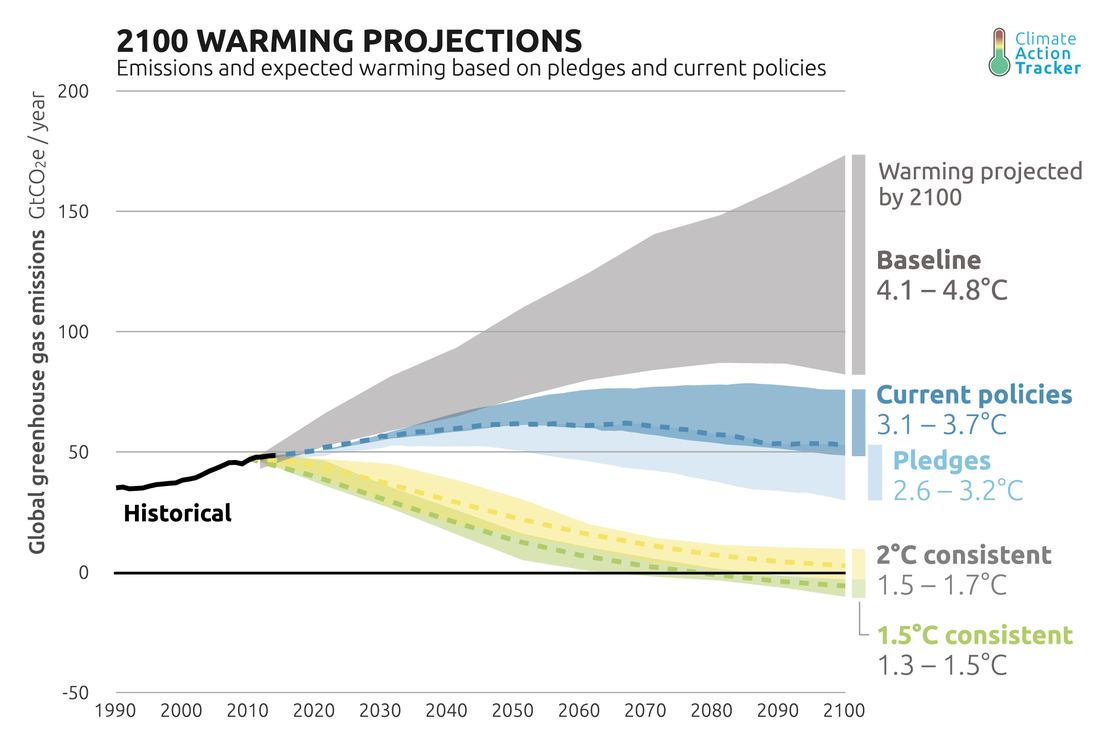
The graph from Climate Action Tracker shows you where things stand; the current pledges from the Paris Agreement for greenhouse gas emissions (the major contributor to climate disruption) are far from adequate to limit warming of our planet to less then 2°C.

Furthermore, according to the IPCC: 
The risks depend on the magnitude and rate of warming, geographic location, levels of development and vulnerability, and on the choices and implementation of adaptation and mitigation options (high confidence).
Avoiding overshoot [of warming above 1.5°C] and reliance on future large-scale deployment of carbon dioxide removal [i.e. geoengineering] can only be achieved if global CO2 emissions start to decline well before 2030 (high confidence).
The year 2030 is not very far away. If you haven't read the details of the Paris Agreement, it focuses on post-2020 actions. Hence the use of the word "pledges" in the above graph.

These are very real threats to our national security, but for the most part, we have yet to address them. Instead of seriously considering our "choices and options" related to mitigation and adaptation, we have largely focused on inaction. Pascal's Wager reminds us that this is typically not the wisest option. Denial and deflection, a previous failure to ratify the now defunct Kyoto Protocol, and more recently, threats to withdraw from the Paris Agreement, have been our modus operandi towards climate change policy. Our borders are under threat, but it is our coastlines that will be washed away with sea level rise. Maybe we need seawalls rather than a wall along the border with Mexico. In the southwest, drought contingency plans are being considered as the serious water shortages in that region of the country will impact our own citizens. [2]
According to NASA, rainfall may decline by 20 to 25 percent over California, Nevada, and Arizona by 2100.
Maybe officials in the southwest are taking note of the water-shortage crisis that Cape Town faced this past year. We have already seen record loss of human life and property from the devastating fires in California, fires which have been made worse by (yes, I am going to say it) climate change. The current numbers of migrants or refugees seeking food, shelter, and protection pale in comparison to what we may face in the coming decades with climate migrants. [3] And some of those displaced people could be U.S. citizens.

Less you think that climate refugees are a problem for the distant future, I invite you to watch a short video that a colleague sent me yesterday with the message: "Thankful we live on high islands in Hawai'i, our Marshallese neighbors are not so fortunate." [An aside since I have been mentioning conflict and war: the Marshalls were an American nuclear testing site in the 1950s with 50 plus bombs dropped there.]

Against this backdrop, and amidst tweets of climate change denial and plans for our administration to promote the virtues of coal, I head to Poland with students in a week to attend the 24th meeting of the Conference of the Parties of the United Nations Framework Convention on Climate Change. The most recent "1.5°C report" from the IPCC is on the agenda. The first of the IPCC reports was published in 1990, and the messages within it brought nations together at the Rio Earth Summit in 1992 to develop the UNFCCC and to act in the interests of human safety even in the face of scientific uncertainty. Now, almost 30 years later and with solid scientific evidence for a changing climate, we still haven't figured out how to solve one of the greatest challenges facing humanity.


[1] Selby, J.,  O.S. Dahi, C. Frohlich, and M. Hulme. 2017. Climate change and the Syrian civil war revisited. Political Geography 60: 232 - 244. https://www.sciencedirect.com/science/article/pii/S0962629816301822

[2] N. Baptiste. 2018. This is What a West Without Water Will Look Like. Mother Jones Magazine, published March 15, 2018.  https://www.motherjones.com/environment/2018/03/this-is-what-a-west-without-water-will-look-like/

[3] Parker, L. (2018) 143 Million People May Soon Become Climate Migrants. National Geographic Online, published March 19, 2018. https://news.nationalgeographic.com/2018/03/climate-migrants-report-world-bank-spd and K.K. Rigaud, A. de Sherbinin, B. Jones, J. Bergmann, V. Clement, K. Ober, J. Schewe, S. Adamo, B. McCusker, S. Heuser, and A. Midgley, Amelia. 2018. Groundswell : Preparing for Internal Climate Migration. World Bank, Washington, DC. © World Bank. https://openknowledge.worldbank.org/handle/10986/29461 License: CC BY 3.0 IGO.