Showing posts with label COP 18. Show all posts

Thursday, November 29, 2012

The Western Debt to “Arabick” Science


In the 17th century, the Europeans rediscovered many of the “Arabick” scientific writings, particularly the writings of 11th century scholar Ibn al-Haytham. At the Museum of Islamic Art, a special exhibition “Arabick Roots” explores the impact these Arabic writings had on the Western scientists, and notes that in some cases “scientists and Arabists became one, as, particularly among astronomers, it became vital to directly read original Arabick texts.” 

Another influence of the Arab culture came through the trade routes, and coffeehouses became particularly popular in the late 17th century.  In London, the coffeehouses were nicknamed “penny universities,” as “for the price of a cup of coffee” one could “hear the great minds of the day discuss the big issues.”  London, Tripoli and Constantinople exchanged ambassadors, and the Royal Society elected one Libyan and two Moroccan ambassadors to their select body by virtue of their interest in science.

As one enters the exhibit, there is a kiosk where one can hear a welcome from one of the female members of the Qatar COP 18 presidential team. Relating the exhibit back to COP 18, she welcomes the opportunity for Qatar to help advance science and climate change, and to lead the debate for policies, green technology and capacity building.

For more, check out www.1001inventions.com/ArabickRoots
And, absolutely check out the remarkable museum itself: http://www.mia.org.qa/landing/index.php/en/


Why Qatar?


Her Excellency Sheikha Mayassa bint Hamad bin Khalifa Al Thani, daughter of the Emir, spoke at the panel on the role of women in climate change on Tuesday, and she indicated that much as the women want to see things through a different lens, so do the people of Qatar. In some ways, it seems incongruous to have the climate talks taking place in an oil-producing country with the highest per capita greenhouse gas emissions.  Her Excellency explained that Qatar is in the process of change itself, especially as it moves from an energy-based economy to a knowledge-based economy.  While she didn’t elaborate, Christiana Figueres, Executive Secretary to the UNFCCC, pointed out that Qatar “fought” for the right to host the conference and put forward many good arguments. 

In many ways, Qatar seems to be behind in terms of environmental policies.  Just this week, they have started a pilot program for city-wide recycling.  Oil is clearly a cheap commodity, with a 15-minute taxi ride costing only $3.50.  SUVs are commonplace.  Yes, they are the second-richest country in the world with the highest per capita emissions.

Despite this, Qatar does seem committed to change.  They have always had to worry about water – they have to rely on desalinated water for all domestic use.  For agricultural use, farmers use water from the aquifer, but they are using 250 million cubic meters/year, and the recharge rate is only 56 million cubic meters/year.  In 2008, global food prices shot up rapidly, and as they import 90% of their food, this was very alarming.  That year, the Qatar National Food Security Program (QNFSP) was established, and they are actively exploring ways to ensure food and water security.  For water, they are moving towards using renewable energy for the desalination process, with excess water being diverted to the aquifer. They are also exploring different agricultural practices, including man-made “oases” with tiered plantings (trees providing shade for lower crops) and urban gardens.

Much of the new construction is “green” and LEED-certified, including the convention center where COP 18 meets.  Qatar also won the bid for the World Cup in soccer for 2022, and they are designing the required new stadiums to be “carbon neutral,” relying heavily on solar panels for the energy to keep the stadiums at a cool 68 degrees Fahrenheit.  

While much of the world will still need to be convinced, I can only be hopeful that Qatar will take the lead in moving from fossil fuels to renewables, and from an energy-based economy to a knowledge-based economy. Like the rest of the world, they recognize that they are vulnerable to climate change, and they are taking steps for mitigation and adaptation.

Wednesday, November 28, 2012

The State of the Climate


At each COP, there has been a United States Center, which presents a series of talks highlighting some of the latest research and findings from the governmental organizations, notably NASA, NOAA and the State Department.  For those of you wanting to participate online, check out their events at www.ustream.tv/uscenter.  The events are streamed online with an opportunity for questions via twitter feed.   Upcoming presentations include: The New Normal? Extreme Events Today and What That Can Teach Us About Adaption for Tomorrow; Climate Change, Agriculture, and Drought – Lessons from the 2012 Growing Season; Understanding Climate Change and the Redistribution of Heat, Winds, Water, and Worries; Driving a Low Carbon Future: The Enhancing Capacity for Low Emissions Development Strategies Program; and U.S. Climate Finance 2010-2012: Meeting the Fast Start Commitment.

Another feature of the US Center is the Hyperwall, providing data visualizations on a 3x3 panel video wall. While we watched the “State of Flux – World of Change,” other presentations include “Eyes on the Earth (3-D presentation),” “Looking Back and Looking Down” and “Landsat: 40 Years of Watching the Earth’s Surface Change – Water, Forest, Food, Urban Growth, Glaciers & Ice.”  

Tuesday’s presentation was “Taking the Pulse of the Planet: the State of the Climate.”  Presenting via Skype, Mike Brewer and Derek Arndt introduced the key charts that were published in the Annual State of the Climate Report for 2011. With 387 authors from 48 countries, this report tracks 43 climate indicators, both for 2011 and longer term. 

In terms of climate change, the changes are consistent with a warming world.  Sea level, temperatures and land temperatures are rising, while sea ice, snow, and glaciers are diminishing.  Two new climate variables were added for the 2011 report: ocean acidity (increasing) and albedo (decreasing).  They noted that there is “Arctic amplification,” with more rapid changes in the Arctic, likely because of the positive feedback mechanisms.  There was a record set for ocean temperatures, along with an increase in the hydrological cycle.  In the past ten decades, the average increase was just over .1° F; in the past three decades, the average increase was just over .3° F. At the end of the presentation one of the audience members summed up the mood: “How depressing.”

And the winner is ...


At the end of every day, crowds gather for the “Fossil of the Day” award ceremony.  Last year, one of our delegates, Corey Husic, accepted the award on behalf of the United States. [http://www.youtube.com/watch?v=aWIVmYLsJbI&feature=player_embedded]
On the first day, the 1st place award went jointly to the USA, Canada, Russia, Japan and New Zealand for their unwillingness to participate in a legally binding, multilateral rules based regime.  New Zealand also won 2nd  place for having participated in negotiations but then refusing to put in a target for a second commitment period.  The second day’s 1st place award went to Turkey, the world’s largest investor in coal at the same time they are asking for more funds in climate negotiations. 2nd place went to the EU for putting in a target of a reduction of 20% for 2020, having already essentially achieved that through reductions of 17.5% and offsets.  


Tuesday, November 27, 2012

“China is run by scientists, and the United States is run by lawyers”


Most of China’s leadership comes from a science or engineering background, and for that reason, Dale Wen believes they are more willing to listen to the technical experts on climate change.  Ms. Wen, herself from China, believes this a crucial different between China and the U.S., where the leaders are more likely to have trained in law than science.  Ms. Wen joined the panel of the Third World Network to talk a bit more about China’s position on climate change.
Ms. Wen’s work has been to document the progress China has made in terms of sustainability and to correct some of the misinformation.  By almost any measure, China as devoted more resources into renewable energy than the United States, three times that of the United States when measured in terms of GDP. Yet, China’s support for renewables has also been challenged under the World Trade Organization rules.
China has also suffered from severe droughts and floods, and food security is a major issue.  They are spending 4 trillion yen on rural waterworks and irrigation. They understand that they have to do even more, but they feel undermined by the international organizations. Perhaps most importantly, they do not see the United States taking any leadership role. Ms. Wen says the average Chinese citizen is beginning to think that “China should do what the West does, not what the West says.”
Ms. Wen has written a chapter in the “What Next (vol. 3): Climate Development and Equity” which can be found at www.whatnext.org. Her chapter is entitled “China and Climate Change – Spin, Facts and Realpolitik.” Here she outlines many of the achievements of China, including the following: China set up a comprehensive National Climate Action Program in 2007; China’s vehicle fuel efficiency standards are higher than the United States; and, China’s investment in clean energy nearly doubles the United states at $34.6 billion. 


Ambition and Equity


“Ambition” and “equity” were the two key concepts mentioned most often in a side event sponsored by the Third World Network.  
Meena Raman from Malaysia began by outlining the issues that face us at this particular junction. She noted that the science is clear that massive emissions reductions are necessary now, and that a legally binding treaty is necessary where the amount of emissions deduction is consistent with the science.  We are at a crossroads where we are leaving the two tracks, the Ad Hoc Working Group under the Kyoto Protocol (AWG-KP) and the Ad Hoc Working Group for Long-term Cooperative Action (AWG-LCA) under the Bali Action Plan (BAP), and moving towards the Ad Hoc Working Group on the Durban Platform for Enhanced Action (ADP) which should be in place by 2020.
In the AWG-KP track, the Annex 1 Parties (developed countries and economies in transition) are negotiating a second commitment period of 5 or 8 years and the emission reduction targets. The first commitment period expires at the end of December 2012. The United States never ratified the Kyoto Protocol and withdrew years ago. This past year, Canada dropped out of the Kyoto Protocol, and Japan, Russia and New Zealand have refused to participate in a second commitment period. Australia is undecided, leaving only the European Union. The EU has proposed committing to 20% cut by 2020 compared to 1990, a goal which it has essentially already achieved.  In Ms. Raman’s view, there is nothing ambitious on the table, pointing out that “nobody leaves the Kyoto Protocol to do more.”  Her fear is that we will lose a decade, making it all the more difficult to meet emission reduction targets in the future. 
The Bali Action Plan also called for “comparable efforts,” which the U.S. delegation resists.  At this point, the developing countries feel that they are being expected to take on too much of the burden.  Ms. Raman notes that one out of two of the extreme weather events of recent years have affected developing nations, and yet the developing nations have not been responsible for the historical emissions.   

Monday, November 26, 2012

The U.S. as world leader

After being in airports or airplanes for almost 22 hours, Marla and I finally arrived in Doha late Saturday night.  For the first time in all my travels, I had to show my boarding pass as I disembarked, presumably verifying that a) I had shown proper credentials, including a visa, to board in the first place, and b) that I wasn’t instead supposed to be headed to the next stop of the flight – Bahrain.  One of the flight attendants had warned us ahead of time that photography within the airport was not allowed.  A search of the internet later turned up uninteresting and outdated pictures of the airport in the 1970s and provided information about a new airport (with artist renderings) that is supposed to open in December of this year, after we leave.  Presumably, this is in support of the upcoming World Cup to be held in Qatar in 2022 (talk about planning for the future).

As typical (in my limited experience, at least), flights in the Middle East do not pull up to a jet way at the main airport terminal.  Rather, a bus takes passengers to the terminal.   Our bus from the plane drove seemingly in circles for a good 20 minutes.  It was dark, but I could make out sand, lots of sand, that had blown in piles around the open expanses.  I would later notice that sand is everywhere and everything in Qatar is the color of sand - the ground, the haze, the buildings, the cars...

A scene from our COP18 bus ride
Once inside the terminal, it was the usual cattle-herding-experience of going through passport control/immigration; my picture is now in the Qatari database.  All employees here were male, clothed in fine white robes and wearing head scarves -- white squares of cloth, some embroidered, with black “ropes” to hold the covering in place.  I believe these are referred to as kufiya.  Traditionally, the ropes were made of camel hair, but these looked to be cloth.  Many women, who were not coming off our plane, were completely covered in the black abaya.
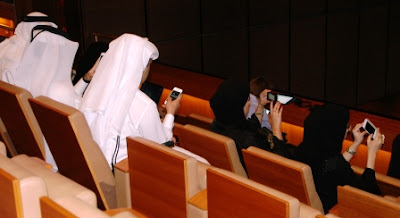
Observers at the Opening Plenary of COP18
The rest of the airport routine was uneventful, and we were relieved to see a driver holding a sign with our names indicating that the prearranged hotel pickup had gone as planned.  The driver was young and dressed such that we might have been in any American city.  In many countries, the youth are rejecting the traditions of their culture; is this true in Qatar as well?  He turned on the radio; the World Top 50 Countdown was on.  I was a bit startled to hear Taylor Swift (We are never ever getting back together).  Next up, Alicia Keys singing Girl on Fire.  This was Doha, right?  Yes, the airport security confirmed that I was in the right destination when I got off the plane.  But bold songs from women in a culture not known for promoting a strong voice from women seemed out of place to say the least.  It was a bit surreal, and I suppressed an urge to giggle at the strange clash of cultures.  But it was late, and I was happy to reach our “home” for the week, Le Park hotel. 

I awoke much too early on Sunday morning, but unable to sleep any longer, I logged in to see what was new in the world.  I was greeted by two main headlines:  the growing unrest in Egypt and the “news” that Larry Hagman had died.  Add the unrest in Egypt to conflicts in Israel and the Gaza strip, Syria, Pakistan, Nigeria, and the Democratic Republic of Congo, and probably many other locations that don’t even make the news in the U.S.  The other CNN story began “Larry Hagman, whose portrayal of one of television’s most beloved villains, J. R. Ewing, led the CBS series ‘Dallas’ to enormous worldwide popularity, died on Friday in Dallas. He was 81.”  Ah, the oil tycoon of an incredibly popular show that aired from 1978 to 1991.  Not exactly the type of oil tycoon here in Qatar, of which there are many.  Sadly, I watched too many episodes of this night-time soap opera in my younger days, especially during graduate school.  I tried to picture J.R., with his sneer and cowboy hat, swaggering through the Gulf state deserts.  Nah, he belongs in Texas and on TV reruns.

My thoughts wandered to a visit to Kenya in 1991.  Several people we met at tented lodges in remote areas of the country mentioned how they dreamed of coming to the United States to see New York City (the iconic image of our entire nation, apparently) and our huge houses.  Many commented that we must be very rich if we live in houses like they saw on Dallas.  (Seriously?) Mind you, this is before the internet was available in this region; we were lucky just to have a few hours of generator power to charge our camera batteries back then.  Apparently, their impressions of our country were obtained from magazines.  Was this the best that America had to offer as aspirations for those living in countries thousands of miles away?  I had seen boys and men wearing T-shirts with American symbols (often the famous Swoosh or some pro sports team), but I figured that these had been gifts or trades from previous tourists.  Most of the schoolchildren we encountered begged for paper, pencil, magazines, or candy. At least 3 of these could be used for educational purposes.

I have had the good fortune of traveling to many countries, and it is readily obvious that the imprint of the United States on the planet is becoming universal.  Coca Cola is recognized even in remote villages, although Fanta is often also a favorite.  McDonalds and Starbucks and KFC are not difficult to find in cities around the world, although we didn’t notice any Starbucks wandering around Doha on Day 1.  Denny’s has become the favorite restaurant of a friend of mine from rural Cariari, Costa Rica.  The McDonalds in Qatar do have a Middle Eastern twist with the unique McArabia and McRoyale sandwiches (you can’t make this stuff up).  We saw signs for “Doha’s Got Talent” (although our American version is actually a knockoff of the original British show, I believe).  Personally, I wish our corporate footprints, or at least these icons, were not so universal.  They really aren’t the best we have as a nation to offer, and personally, I enjoy testing the local fare when I travel and learning about cultures that are unfamiliar to me.  But I doubt that this tide of influence can be reversed.

Given that the United States has so much global influence, it shouldn’t be any surprise that the rest of the world looks to our country for leadership in other areas, including the international climate negotiations.  (That is, after all, the real reason I am here.)  The little media coverage I have seen about the conference thus far, however, has not been optimistic that major breakthroughs will occur over the next two weeks.  After eighteen years of negotiating, our country hasn’t been the most cooperative (a reminder of our not being a signatory to the Kyoto Protocol – the only existing legally binding agreement on greenhouse gas reductions).  From a recent Common Dreams article[1]:

All eyes will be on Barack Obama and whether he demonstrates commitment to climate change early on at Doha. The key question for many is whether or not President Obama will chart new territory for leadership by the United States, a country which has long refused to make the necessary commitments that scientists say are necessary to avert a 2°C rise in global temperatures and the associated climate change such warming is likely to trigger.

Will this now change, given the growing acceptance of climate change being “real” in our country due, in part, to the extreme weather events of the past year and half, especially Hurricane Sandy that hit much of the east coast in October?  Estimates that damage from Sandy are now over $62 billion.  But the U.S. does not have sole claim to extreme weather vents and damage caused by them.  Numerous other episodes around the world over the past few years have also resulted in billions and billions of dollars in losses.  An upcoming event at the COP18 meeting is a discussion of the IPCC 2012 special report entitled “Managing the Risks of Extreme Events and Disasters.”[2]  There are many here who attribute global extreme weather events occurring in increasing frequency to greenhouse gas emissions from the U.S. and other industrialized nations.  Another imprint of our culture that now impacts the rest of the world.

Our carbon emissions of over 5 billion tons annually are surpassed only by China’s 8 billion tons, which have grown significantly since the Kyoto Protocol was negotiated in 1997.  To be fair, our emissions have fallen since 2007, but this is largely due to the economic downturn.  Our per capita carbon footprint, however, remains higher than that of China.  In the days leading up to the start of COP18, our host country, Qatar, is sharing some of the criticism typically reserved for the U.S., given that it produces nearly 50 tons a year of carbon dioxide for each of its 1.6 million residents.   In an article[3] sent to me by a Moravian College colleague this weekend, Jamie Henn, co-founder of the environment group 350.org, noted the irony of Qatar hosting the event: "This is a little bit like McDonald's hosting a conference on obesity."  Those more optimistic instead hope that Qatar pours their innovative energy into this conference in the same way they put together a creative bid for the World Cup.

Christiana Figueres addressing the audience (parties, press, and observers) at the COP18 opening plenary
 In the opening plenary for COP18, UNFCCC Executive Secretary, Christiana Figueres, noted the unique geopolitical location for this conference as it is the first time such a meeting has been held in the Gulf region.  She noted that this gives Qatar and the Middle East region an “unequaled world stage to showcase contributions to reduce food and water vulnerabilities” and to “build a safer, stronger energy future for all countries.”  The plenary began with a video encouraging the creative of an “Earth conscious world.”  Let’s hope that the 194 nations represented here, including the United States, realize the deep impact that we have on each other.  In the opening plenary, the COP18 president, His Excellency Abdullah Bin Hamad Al-Attiyah, noted that the “phenomenon of climate change is a common challenge for all of humanity” and the outgoing COP17 President from South Africa, Ms. Maiti Nkoana-Mashabane, reminded the audience “that our futures are explicatively linked to each other.”  I am pretty sure that she means in ways more substantial that the sodas and hamburgers we share.


[1]See 11/24/12 piece entitled “US Leadership, Global Solidarity Keys to Averting Climate Disaster”, available at http://www.commondreams.org/headline/2012/11/24-0.
[3] “Qatar hosts climate summit amid criticism”, see http://www.aljazeera.com/news/middleeast/2012/11/201211256573379361.html.